
Hit by an Uninsured Driver in Florida? Your Legal Options in Palm Beach County
By Shannon J. Sagan, The Dash Cam Lawyer® — Florida Bar #10793
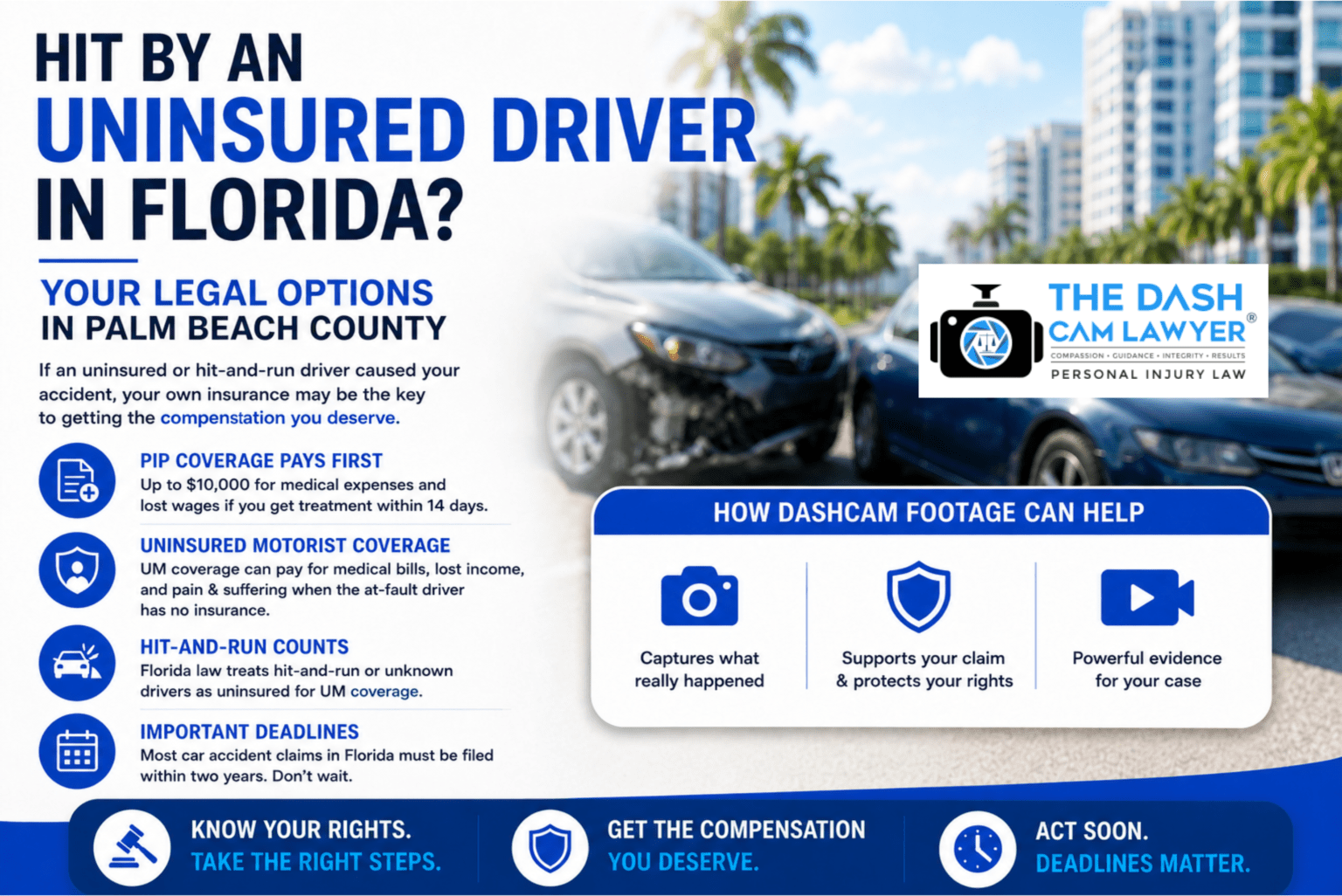
If an uninsured driver hits you in Florida, your own car insurance is usually the first source of recovery. Personal Injury Protection (PIP) pays up to $10,000 in medical benefits if you begin treatment within 14 days, and uninsured motorist (UM) coverage, if you carry it (most people do not), can pay for damages the at-fault driver cannot. Most crash claims must be filed within two years.
Uninsured drivers are a real problem on Palm Beach County roads
Florida consistently ranks among the states with the highest share of uninsured drivers. Recent Insurance Research Council data puts the figure at roughly one in five Florida drivers and that, in my opinion, is a huge understatement. When you add those numbers along with the fact that Florida is one of the few states left in the country that does not require most private passenger drivers to carry bodily injury (BI) liability coverage at all, things can get really bad for anyone driving on the roads. A driver can be fully “legal” on I-95, Okeechobee Boulevard, Southern Boulevard, or Military Trail carrying only $10,000 in PIP and $10,000 in property damage liability, but nothing available to pay for the injuries they cause you.
That means an “uninsured driver” problem in Palm Beach County is really two problems: drivers with no policy at all, and drivers who have policies but the bare minimum which simply do not cover your injuries. The law treats both situations largely the same way from your side of the claim.
As of writing this article, my office is seeing roughly 35-40% of my injured clients being hit by someone who is underinsured and/or carries $0 in bodily injury coverage. Add that to the fact that 8 out of 10 of my clients do not carry Uninsured or Underinsured Motorist coverage, there is nothing I (nor any other lawyer most likely) can or will do to pursue an individual driver who injured you and has little to no insurance coverage.
Step one: PIP and Florida’s 14-day rule (Fla. Stat. § 627.736)
Florida is a no-fault state. After almost any crash, your own PIP coverage is the first payer, regardless of who caused the collision. It’s a point of contention with alot of my clients because they want to know why their own insurance has to pay for medical bills they did not cause. I get it, but that’s the silly law we have had in place for a long long time now.
PIP pays 80% of reasonable medical expenses and 60% of lost income, up to $10,000. Two details trip people up:
- The 14-day rule. You must receive initial medical care within 14 days of the crash. Miss that window and PIP benefits can be lost entirely (Fla. Stat. § 627.736(1)(a)).
- The emergency medical condition (EMC) limit. Unless a qualifying provider determines you had an emergency medical condition, PIP benefits are capped at $2,500 instead of $10,000.
If an uninsured driver hit you, PIP is only the floor. Serious injuries exhaust $10,000 quickly, which is where uninsured motorist coverage comes in.
What uninsured motorist coverage is and how it works (Fla. Stat. § 627.727)
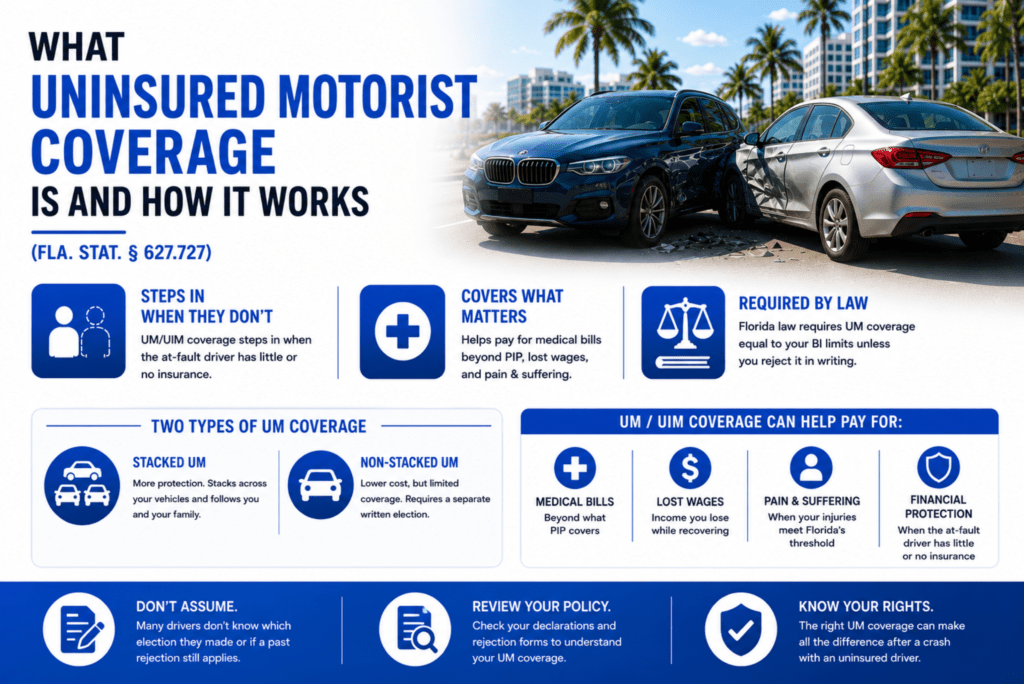
Uninsured motorist (UM) coverage which also includes underinsured motorist (UIM) protection steps into the shoes of the at-fault driver’s missing liability insurance. It can pay for medical bills beyond PIP, lost wages, and, when your injuries meet Florida’s threshold, pain and suffering.
Under Fla. Stat. § 627.727, every Florida policy that includes BI liability coverage must include UM coverage at limits equal to the BI limits unless the named insured rejects UM or selects lower limits in writing on a state-approved form. Florida also distinguishes between two forms of the coverage:
- Stacked UM multiplies protection across the vehicles on your policy and generally follows you and resident family members even outside the insured car.
- Non-stacked UM is cheaper but narrower, and requires a separate written election.
Many Palm Beach County drivers do not know which election they made or that a signed rejection form from years ago is still controlling their coverage today. Reviewing the policy declarations and the rejection forms is one of the first things we do in an uninsured driver case, because the difference between stacked and non-stacked, or between rejected and full UM, can change the available recovery dramatically.
Hit-and-run and “phantom vehicle” crashes count as uninsured
Florida law treats a hit-and-run or never-identified driver as an uninsured driver for UM purposes. If someone sideswipes you on Southern Boulevard and disappears, or runs you off the road without ever making contact, a UM claim may still be available, but the evidence burden is higher, because the insurer will want proof that the phantom vehicle actually existed and actually caused the crash.
This is where dashcam footage earns its keep. Video showing the other vehicle’s movement and your response can be the difference between a paid claim and a denial. Florida evidence rules require authentication, a witness with knowledge testifying that the recording fairly and accurately shows what happened (Fla. Stat. § 90.901), and a duplicate copy is generally acceptable when authenticity is not genuinely disputed (Fla. Stat. § 90.953). Two practical cautions:
- Preserve the file immediately. Most dashcams record on a loop and overwrite footage within days. Save the clip to your phone and a second location the same day.
- Mind the audio. Florida is an all-party consent state (Fla. Stat. § 934.03). Cabin audio that captures passengers’ conversations without consent can create admissibility problems and legal exposure. Video of the roadway is the safer core of your evidence.
What you can recover and the deadlines that control your claim
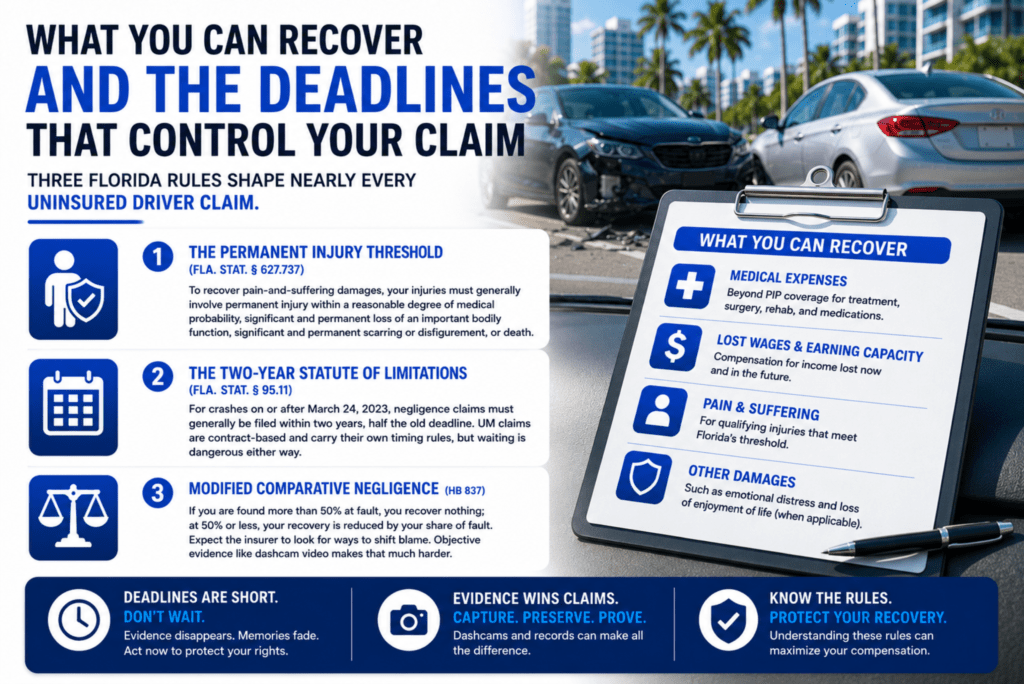
Three Florida rules shape nearly every uninsured driver claim:
- The permanent injury threshold (Fla. Stat. § 627.737). To recover pain-and-suffering damages arising out of a motor vehicle crash, your injuries generally must involve permanent injury within a reasonable degree of medical probability, significant and permanent loss of an important bodily function, significant and permanent scarring or disfigurement, or death.
- The two-year statute of limitations (Fla. Stat. § 95.11). For crashes occurring on or after March 24, 2023, negligence claims must generally be filed within two years, half the old deadline. UM claims are contract-based and carry their own timing rules, but waiting is dangerous either way.
- Modified comparative negligence (HB 837). If you are found more than 50% at fault, you recover nothing; at 50% or less, your recovery is reduced by your share of fault. Expect the insurer to look for ways to shift blame. Objective evidence like dashcam video makes that much harder.
Can you sue an uninsured driver personally?
Yes, but a judgment is only worth what can be collected, it is difficult to find a lawyer who will pursue that avenue for you on a contingency basis (I and my colleagues I have talked to do not), and a driver who could not afford insurance rarely has assets to pay one. That is why the practical path in most uninsured driver cases runs through your own UM coverage, and why it is worth investigating every other potentially responsible party: the vehicle’s owner (Florida’s dangerous instrumentality doctrine can make an owner responsible for a permissive driver’s negligence), an employer if the driver was working, or a commercial policy covering the vehicle. An experienced review often finds coverage where the crash report shows none.
What to do in the first 14 days after a crash with an uninsured driver
- Report the crash to law enforcement at the scene, essential in every case, and legally and practically critical after a hit-and-run.
- Get medical care within 14 days to protect your PIP benefits, and follow through with treatment.
- Preserve your evidence: save dashcam footage immediately, photograph vehicles and the scene, and collect witness contact information.
- You do not have to Notify your own insurer right away. Although UM policies contain notice and cooperation conditions, and late notice can jeopardize the claim, talking to an injury lawyer is your best bet, as most if not all injury lawyers offer free consultations.
- If you were on the fence about getting a lawyer involved, just remember to be careful giving recorded statements and taking quick settlement offers from insurance carriers because you were not thinking long term. Once you sign a release, in most cases, your claim is over.
- Talk to a lawyer before signing anything. A consultation costs nothing, and the coverage questions in uninsured driver cases are rarely as simple as they look.
Frequently asked questions
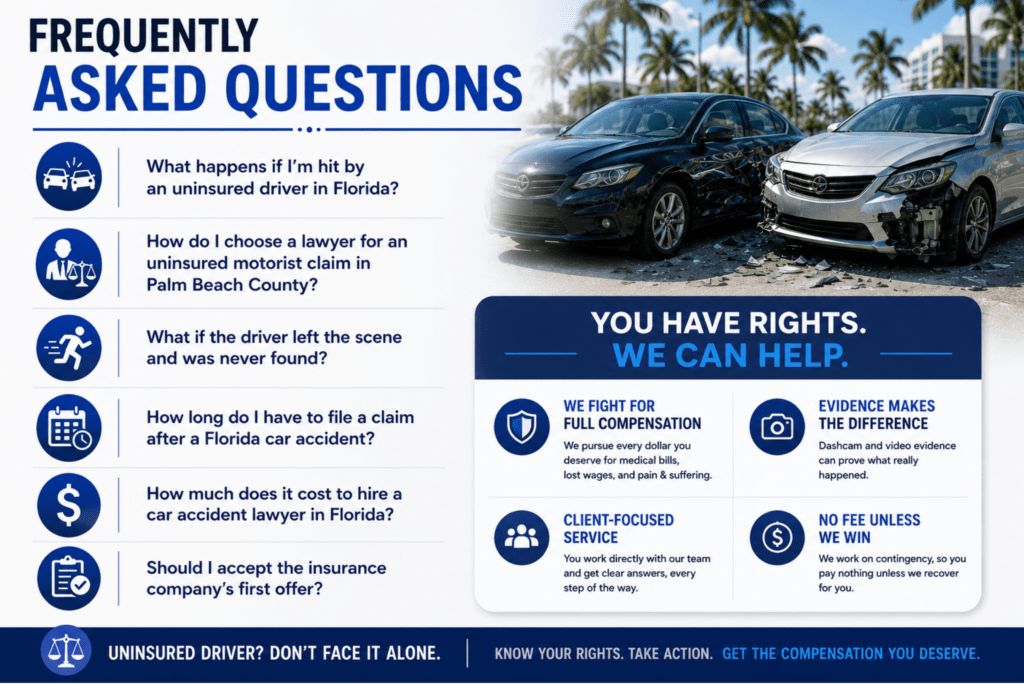
What happens if I’m hit by an uninsured driver in Florida?
Your own PIP coverage pays first, up to $10,000 in medical and lost-wage benefits if you treat within 14 days. Beyond that, recovery usually comes from your uninsured motorist coverage if you carry it, from other responsible parties (such as the vehicle’s owner or the driver’s employer), or rarely collectible from the driver personally.
How do I choose a lawyer for an uninsured motorist claim in Palm Beach County?
Look for a firm that handles UM claims regularly, will review your policy elections (stacking and rejection forms) at the start, works on contingency, and communicates directly with you. Ask who will actually handle your file and how the firm approaches evidence in our practice, that includes preserving and authenticating dashcam and video evidence early.
What if the driver left the scene and was never found?
A hit-and-run driver is treated as uninsured under Florida law, so your UM coverage can apply. Report the crash to law enforcement immediately and preserve every piece of corroborating evidence dashcam video, nearby camera footage, witness information because insurers scrutinize phantom-vehicle claims closely.
How long do I have to file a claim after a Florida car accident?
For crashes on or after March 24, 2023, Florida’s negligence statute of limitations is two years (Fla. Stat. § 95.11). UM claims follow contract-law timing principles that can differ, but the safe course is the same: act well before any deadline could become an issue.
How much does it cost to hire a car accident lawyer in Florida?
Most Florida injury firms, including ours, work on contingency: no fee unless we recover for you. The consultation is free, and case costs are typically advanced by the firm and repaid from the recovery.
Should I accept the insurance company’s first offer?
Not before you understand the full value of your claim, including future medical care, lost earning capacity, and whether your injuries meet Florida’s permanent injury threshold. First offers in UM cases are frequently made before that picture is complete, and accepting one ends the claim permanently.
Talk to The Dash Cam Lawyer® about your uninsured driver claim
If you or a family member were hurt by an uninsured, underinsured, or hit-and-run driver anywhere in Palm Beach County: West Palm Beach, Boynton Beach, Delray Beach, Lake Worth Beach, Wellington, Royal Palm Beach, Belle Glade, or the surrounding communities, The Dash Cam Lawyer® offers a free consultation to review your crash, your policy, and your options. There is no fee unless we recover for you. Call 561-561-DASH (3274) or contact us online.
This article is for general information only and is not legal advice. Reading it does not create an attorney-client relationship. Every case is different; consult a licensed Florida attorney about your specific situation.

Looking for an accident Lawyer near you in Palm Beach County? Find Out What Your Case Is Worth - Free Consultation
Call us or complete the form below.
We'll keep your information confidential.
Palm Springs Office
Belle Glade Office
By appointment only