
How to Use Dashcam Footage in a Florida Car Accident Claim
By Shannon J. Sagan, Esq. — The Dash Cam Lawyer® | Palm Beach County, Florida
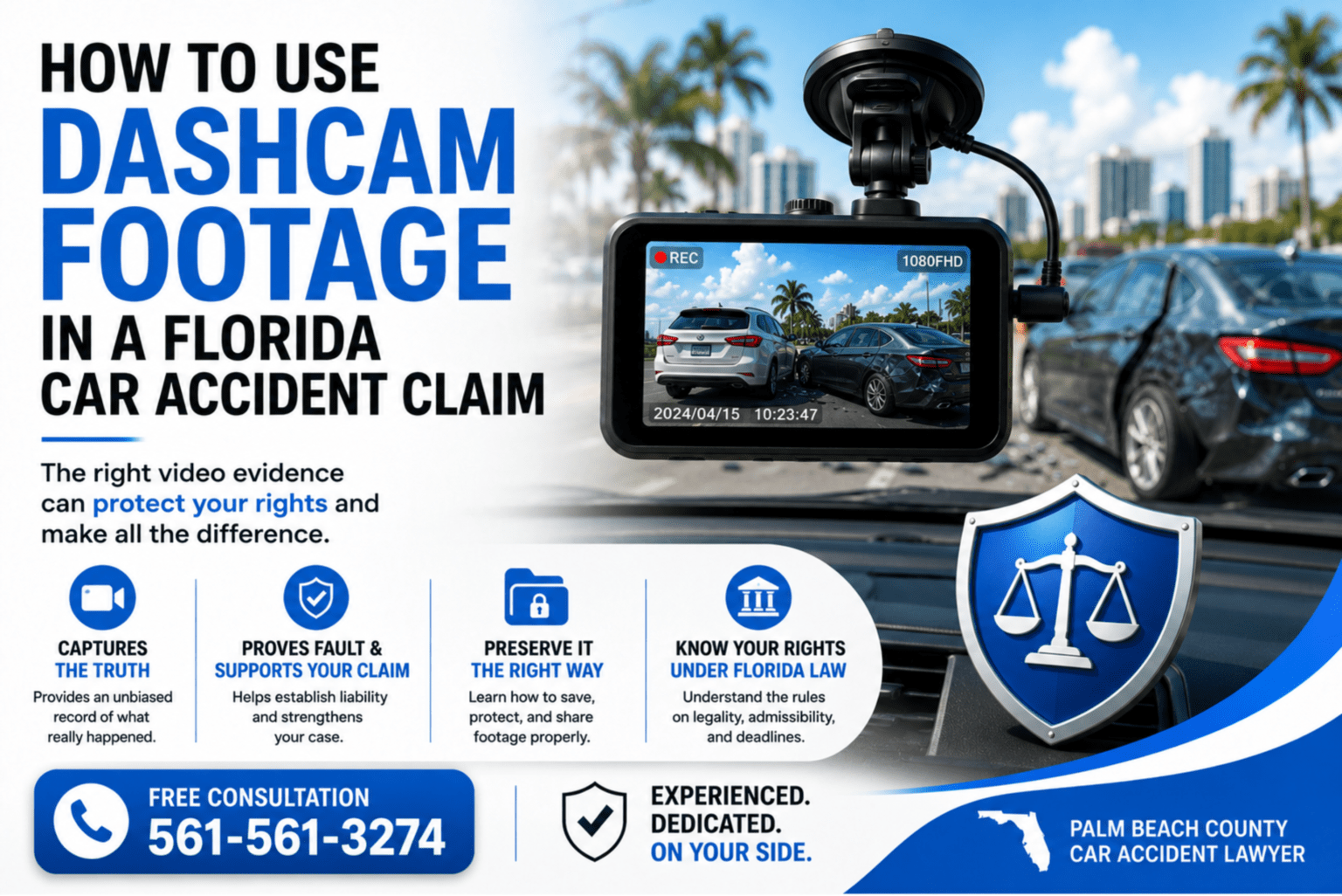
Dashcam video is generally legal to record on Florida roads and can be used as evidence in your car accident claim if it is authentic, unaltered, and relevant. To use it effectively: preserve the original file immediately, make backup copies, never edit the footage, and have an attorney review it before sharing it with any insurance company. If the footage belongs to another driver or a trucking company, an attorney can send a preservation (spoliation) letter before it is deleted. Many systems overwrite footage in 30 to 90 days so get in touch with a lawyer right away so they can get that preservation letter out. .
Why dashcam footage matters more than ever in Florida
Florida changed its negligence law in 2023. Under House Bill 837, Florida moved from pure comparative negligence to a modified comparative negligence system. If you are found more than 50% at fault for your own crash, you recover nothing. If you are 50% or less at fault, your recovery is reduced by your percentage of fault.
That single change turned fault percentage into the central battleground of nearly every Florida car accident claim. Insurance adjusters know that pushing your share of fault above the 50% line eliminates the claim entirely. Objective video evidence like a continuous recording of the seconds before, during, and after a collision, is one of the most direct ways to establish what actually happened, rather than relying on competing recollections.
Dashcam footage can document the other driver’s speed, lane position, signal use, and behavior; road, weather, and lighting conditions; and the immediate aftermath of the impact. In a dispute where each driver blames the other, that record can be the difference between a contested claim and a documented one.
Is it legal to record with a dashcam in Florida?
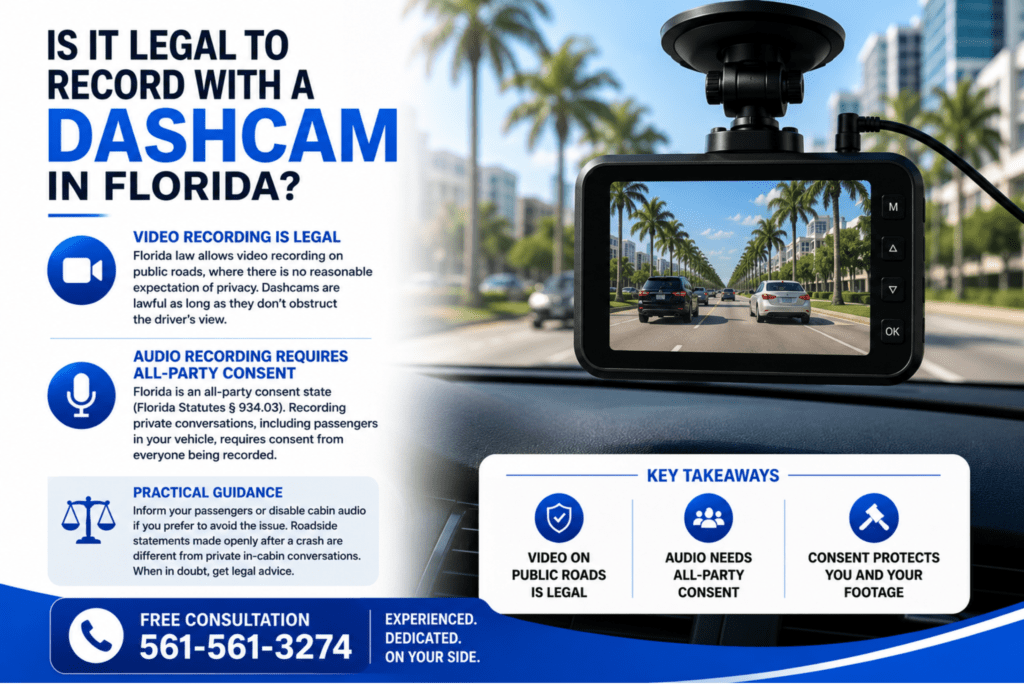
Yes. Florida law does not prohibit recording video on public roads, where there is no reasonable expectation of privacy. A windshield- or dash-mounted camera is lawful, though it should be positioned so it does not obstruct the driver’s view.
Audio is different. Florida is an all-party consent state under Florida Statutes section 934.03. Recording a private conversation, including passengers inside your own vehicle generally requires the consent of everyone being recorded. Unlawful audio recording can carry criminal exposure and can complicate the use of your footage. Practical guidance: if your dashcam records cabin audio, inform your passengers, or disable the audio function if you prefer to avoid the issue entirely. Roadside statements made openly after a crash stand on different footing than private in-cabin conversations, but this is a fact-specific question an attorney should evaluate.
Will a Florida court or insurer accept my dashcam footage?
Insurance companies routinely review dashcam video during claim investigations. For litigation, Florida courts apply standard evidence rules. To be admissible, footage generally must be:
- Authentic. Under Florida Statutes section 90.901, evidence must be authenticated, that is someone with knowledge (usually the driver) must be able to testify the video fairly and accurately shows what happened, and metadata such as time stamps helps.
- Unaltered. Editing, trimming, or “cleaning up” the file can destroy its evidentiary value and invite tampering arguments. Preserve the original file exactly as recorded.
- Relevant. The footage must relate to the disputed issues, such as fault, speed, conditions, or injuries.
- Lawfully obtained. Video from public roads qualifies; audio recorded in violation of section 934.03 may be excluded.
A documented chain of custody must be kept. Who has had the file, where it has been stored, and that it has not been modified helps strengthen all four elements.
Step by step: using your dashcam footage in a claim
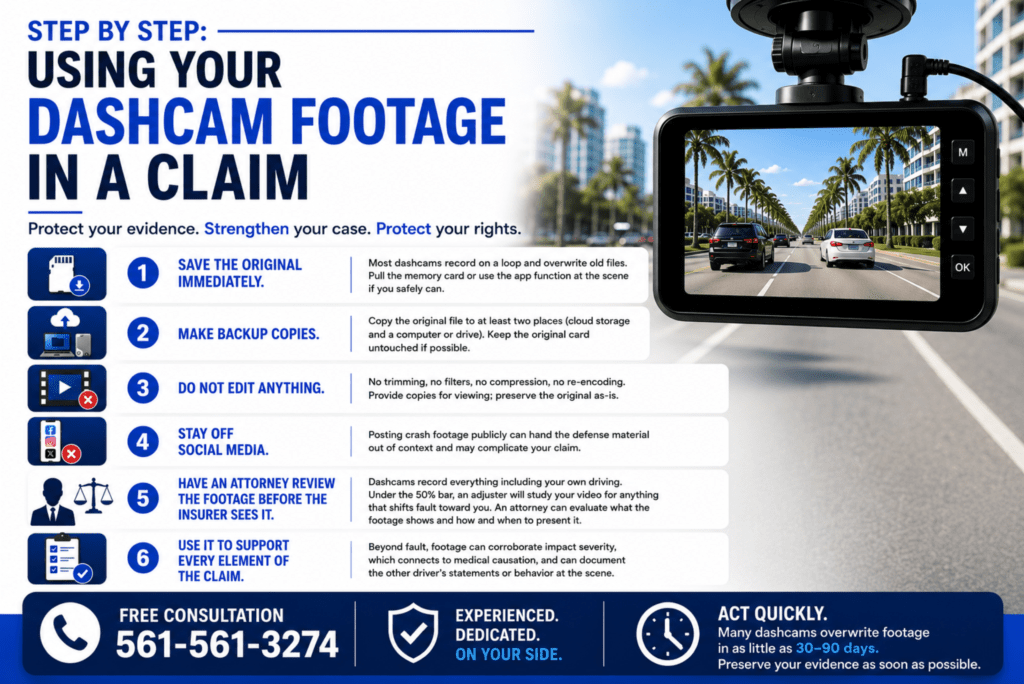
- Save the original immediately. Most dashcams record on a loop and overwrite old files. Pull the memory card or use the app function at the scene if you safely can.
- Make backup copies. Copy the original file to at least two places (cloud storage and a computer or drive). Keep the original card untouched if possible.
- Do not edit anything. No trimming, no filters, no compression, no re-encoding. Provide copies for viewing; preserve the original as-is.
- Stay off social media. Posting crash footage publicly can hand the defense material out of context and may complicate your claim.
- Have an attorney review the footage before the insurer sees it. Dashcams record everything including your own driving. Under the 50% bar, an adjuster will study your video for anything that shifts fault toward you. An attorney can evaluate what the footage shows and how and when to present it.
- Use it to support every element of the claim. Beyond fault, footage can corroborate impact severity, which connects to medical causation, and can document the other driver’s statements or behavior at the scene.
When the key footage belongs to someone else
Sometimes the most important camera is not yours. Commercial trucks, rideshare vehicles, delivery vans, buses, and other passenger cars increasingly carry cameras. Two facts matter:
- Retention windows are short. Many commercial dashcam and telematics systems overwrite footage within 30 to 90 days and sometimes much sooner for routine (non-event) recording.
- Companies are not required to volunteer it. You generally need a formal demand to lock it down.
This is where a preservation letter, often called a spoliation letter, comes in. An attorney sends written notice to the trucking company, driver, and insurer demanding preservation of dashcam video, electronic control module (black box) data, driver logs, and dispatch records. Once on notice, destroying or overwriting that evidence can expose the company to court sanctions, including an adverse inference instruction where the jury may be told to assume the destroyed evidence was unfavorable to the company. Federal motor carrier regulations also require carriers to retain claim-related records once a claim is noticed, but those rules do not automatically capture loop-recorded video, which is why speed matters.
If another driver’s dashcam captured your crash, get their contact information at the scene and tell your attorney immediately. Tthe same preservation principles apply.
Deadlines that can decide your claim
- Two years to file suit. For crashes occurring after March 24, 2023, Florida’s statute of limitations for negligence claims is two years from the date of the crash (Florida Statutes section 95.11). Missing it generally ends the claim.
- Fourteen days for PIP benefits. Florida’s no-fault system requires you to seek initial medical treatment within 14 days of the accident to access personal injury protection benefits (Florida Statutes section 627.736).
- Thirty to ninety days (or less) before third-party footage disappears. Not a legal deadline, a practical one. Preservation demands should go out as early as possible.
Frequently asked questions
Is dashcam footage admissible in a Florida car accident case?
Generally yes, if it is authenticated under Florida Statutes section 90.901, relevant, unaltered, and lawfully recorded. Video from public roads is routinely accepted; in-cabin audio recorded without all-party consent may be excluded.
Are dashcams legal in Florida?
Yes. Video recording on public roads is lawful. Audio recording of private conversations requires the consent of all parties under Florida Statutes section 934.03, so inform passengers or disable cabin audio. Mount the camera so it does not obstruct your view.
Can my own dashcam footage be used against me?
Yes. Your camera records your driving too, and under Florida’s modified comparative negligence rule, an insurer will look for anything that pushes your fault share above 50%, which would bar recovery. That is a key reason to have an attorney review footage before sharing it.
How do I get dashcam footage from a truck or another driver?
Through a prompt preservation (spoliation) demand and, if suit is filed, formal discovery. Commercial systems often overwrite footage within 30 to 90 days, so the demand should be sent as soon as possible after the crash.
How long do dashcams keep footage after an accident?
Consumer dashcams record on a loop and may overwrite within days unless the file is locked. Commercial fleet systems commonly retain event-triggered clips for 30 to 90 days. Treat preservation as urgent in every case.
Should I send my dashcam video to the insurance company?
Not before it has been reviewed. You may have duties to cooperate with your own insurer, but timing and presentation matter, and the other driver’s insurer is not entitled to immediate access. Get legal advice first.
What if the video shows I was partly at fault?
Partial fault does not necessarily bar recovery. If you are 50% or less at fault, you can still recover damages reduced by your percentage. The footage’s context, speed, conditions, the other driver’s conduc still matters, and an attorney can assess how it plays under HB 837.
How long do I have to file a car accident lawsuit in Florida?
Two years from the date of the crash for most negligence claims arising after March 24, 2023. Earlier action protects evidence, including video.
Have dashcam footage from a Palm Beach County crash?
Shannon J. Sagan is The Dash Cam Lawyer® — a Palm Beach County personal injury attorney whose practice focuses on using video evidence in car and truck accident claims. If you or another driver captured your crash on camera, we can review the footage, act to preserve evidence before it is overwritten, and explain your options. Consultations are free, and there is no fee unless we recover for you.
Call 561-561-3274 or contact us online. Serving West Palm Beach, Boynton Beach, Palm Beach Gardens, Belle Glade, Lake Worth, and all of Palm Beach County.
This article is for general information only and is not legal advice. Reading it does not create an attorney-client relationship. Every case is different; consult a licensed Florida attorney about your specific situation.
Looking for an accident Lawyer near you in Palm Beach County? Find Out What Your Case Is Worth - Free Consultation
Call us or complete the form below.
We'll keep your information confidential.
Palm Springs Office
Belle Glade Office
By appointment only