
Can I Settle My Own Florida Car Accident Claim If I Have Dash Cam Video?
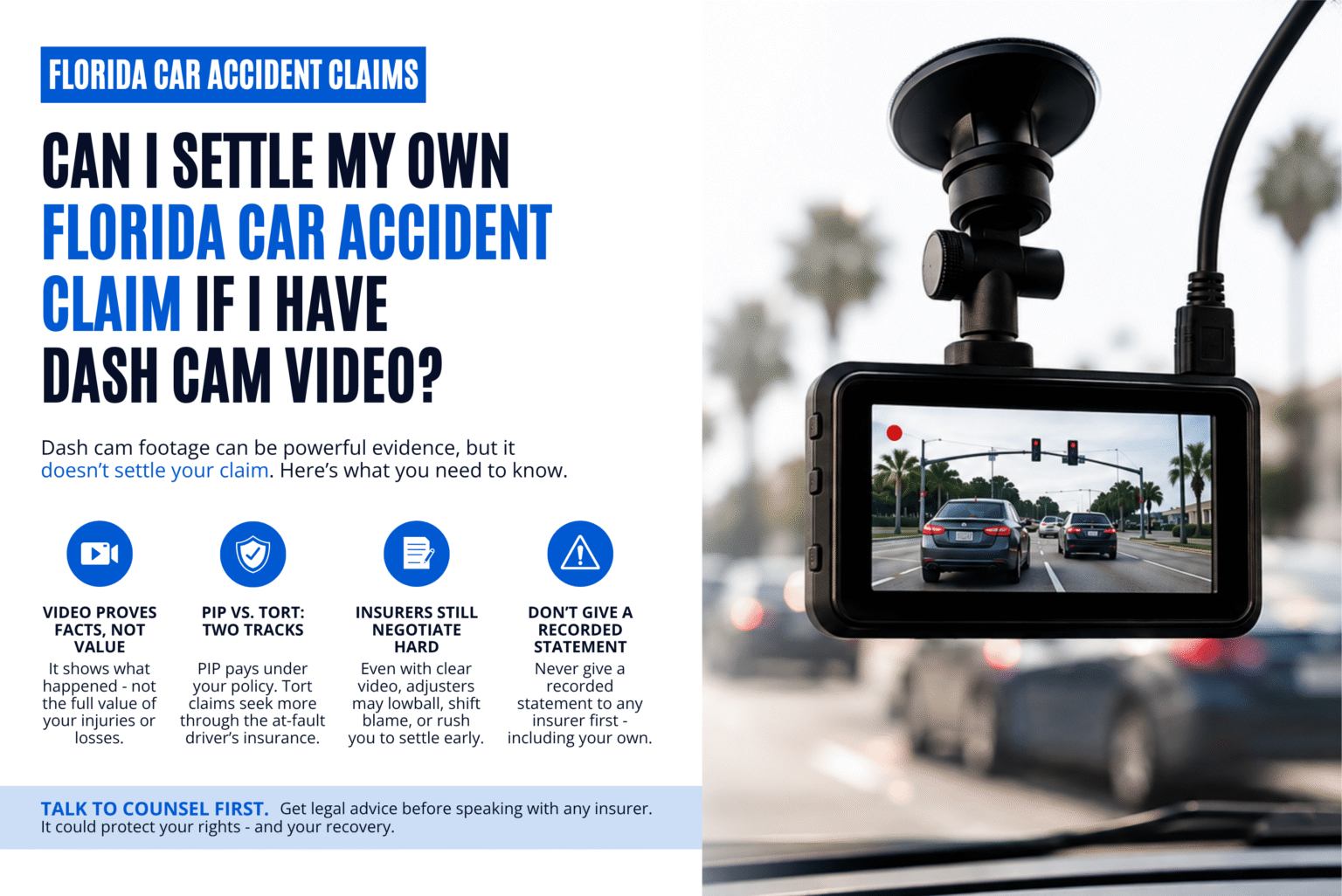
You filmed the crash. The other driver ran the light, drifted into your lane, or rear-ended you, and your dash cam caught it. You have proof. So can you settle the claim yourself?
Short answer: video helps prove what happened. It does not run the claim, set the value, or stop an insurer from negotiating against you. Dash cam footage is evidence. Settlement is a strategy. Those are not the same thing.
I am Shannon J. Sagan, Fla. Bar #10793, The Dash Cam Lawyer®. My practice focuses on Palm Beach County injury claims where video matters. This article covers what footage does (and does not do) in a DIY settlement, PIP vs tort, and the insurer traps that catch people who think the video alone will close the file.
Important: talk to counsel before you call any insurer
Do not call your own insurer before speaking with an attorney. The duty to cooperate with your own carrier is real, but it does not require you to do it immediately. Never give a recorded statement to any insurer first, including your own and the other driver’s. Get legal advice before you dial.
Video proves facts. It does not settle the claim.
A clear dash cam clip can show speed, lane position, signal use, weather, and the sequence of impact. Under Fla. Stat. § 768.81(6), a person found greater than 50 percent at fault for their own harm generally cannot recover in a negligence case. Video can push fault percentages toward or away from that line.
What video does not do: set the value of medical bills, future care, lost wages, or pain damages. Force the other driver’s insurer to accept your demand, fix treatment gaps or a premature settlement, or replace policy-limit research and negotiation judgment.
Insurers settle every day against people who have strong video and no lawyer. They still discount soft-tissue cases, argue causation, and push early releases. Footage reduces “he said, she said.” It does not remove the business model.
PIP vs tort: two different tracks
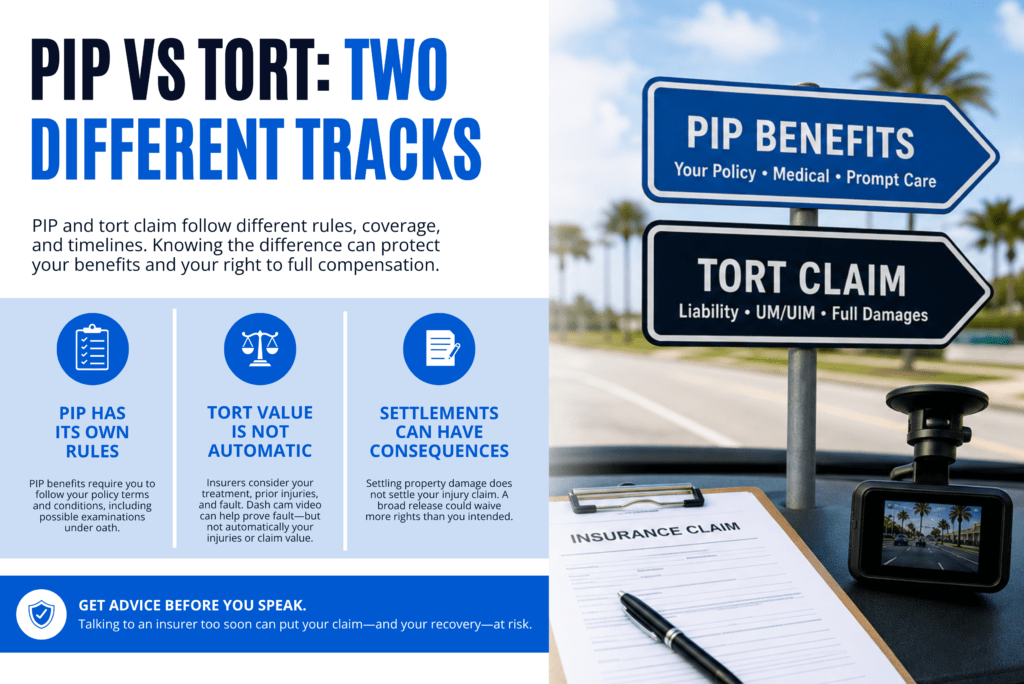
Under Fla. Stat. § 627.736, personal injury protection (PIP) can pay a portion of medical expenses and related benefits according to the policy and statute, regardless of who caused the crash (subject to eligibility rules such as timely care).
PIP is usually against your own policy. A tort claim for pain, suffering, and other damages beyond PIP often runs against the at-fault driver’s liability coverage (or your UM/UIM coverage when that applies). Key DIY traps:
• PIP has its own conditions. Fla. Stat. § 627.736(6)(g) provides that an insured seeking PIP benefits must comply with policy terms, which can include an examination under oath, and compliance is a condition precedent to receiving those benefits. That is cooperation for PIP, not a green light for a free-form recorded statement to the liability adjuster on day one.
• Tort value is not “whatever the ER billed.” Liability adjusters evaluate treatment consistency, prior injuries, and comparative fault. Your video may help fault. It does not automatically prove medical causation or claim value.
• Settling property damage quickly is not the same as settling the injury claim. Signing a broad release can wipe out more than you intended.
Why insurers still negotiate hard against unrepresented claimants
Adjusters resolve files efficiently for the company. When you are unrepresented, common patterns include:
1. Early contact. They ask for “your side,” then push for a recorded statement while you are still in pain or unsure of your diagnosis.
2. Low first offers framed as fair. They cite soft-tissue ranges, not your specific records or future needs.
3. Fault spinning even with video. They may argue you could have avoided the crash or that the angle shows shared blame. Under § 768.81(6), pushing you over 50 percent ends the tort recovery.
4. Rushing before you know the full injury picture. An early number can leave later care unpaid.
5. Using your own words against you. Casual comments like “I’m fine” become claim exhibits.
Dash cam video does not stop those moves.
Recorded statements: the DIY claim killer
Never give a recorded statement to any insurer first. That includes the other driver’s carrier and your own.
With video on the table, the adjuster often already has (or will ask for) the clip. The recorded statement is about locking your narrative and hunting inconsistencies with the video, the police report, or later medical notes. You do not control the framing.
Your duty to cooperate with your own insurer for PIP and policy compliance is real. Fla. Stat. § 627.736(6)(g) underscores that policy-term compliance (including examination under oath when required) can be a condition precedent to PIP benefits. Cooperation does not mean you must call immediately after the crash or give a recorded statement before you have talked to a lawyer. Sequence matters. Call counsel first.
If you still plan to handle it yourself
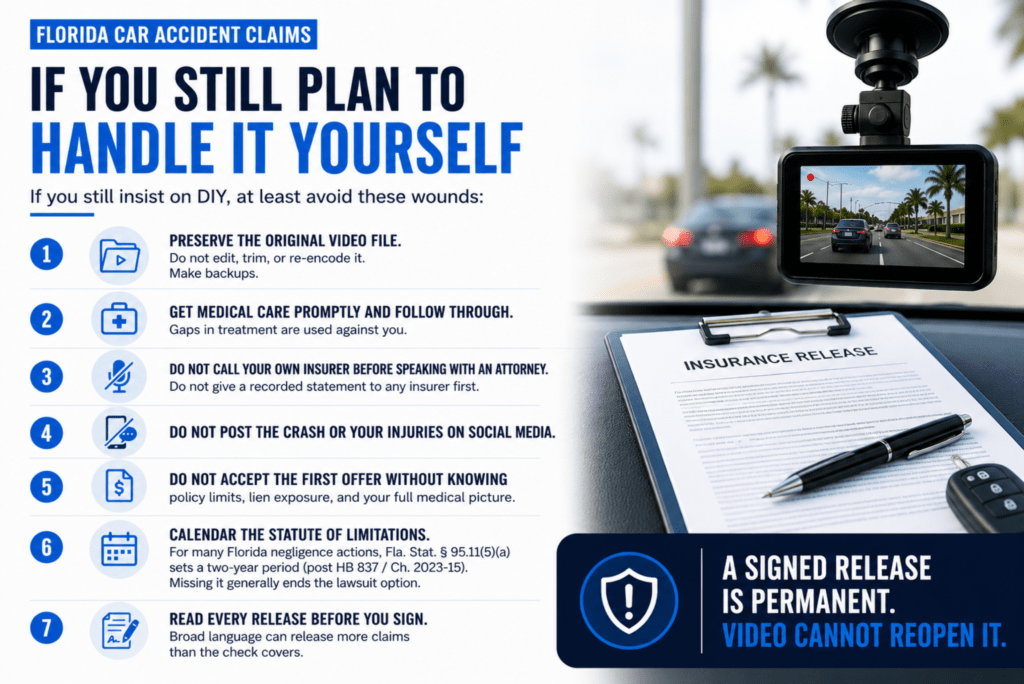
If you still insist on DIY, at least avoid these wounds:
1. Preserve the original video file. Do not edit, trim, or re-encode it. Make backups.
2. Get medical care promptly and follow through. Gaps are used against you.
3. Do not call your own insurer before speaking with an attorney. Do not give a recorded statement to any insurer first.
4. Do not post the crash or your injuries on social media.
5. Do not accept the first offer without knowing policy limits, lien exposure, and your full medical picture.
6. Calendar the statute of limitations. For many Florida negligence actions, Fla. Stat. § 95.11(5)(a) sets a two-year period (post HB 837 / Ch. 2023-15). Missing it generally ends the lawsuit option.
7. Read every release before you sign. Broad language can release more claims than the check covers.
A signed release is permanent. Video cannot reopen it.
When clear video still leaves you underpaid
Common DIY outcomes: clear fault video with a low offer that ignores future care, minimal bodily injury limits and no UM/UIM check, causation fights over prior injuries or imaging, a recorded statement that conflicts with later medical notes, or a property-damage release broader than you realized. Video answered who hit whom. The claim still turns on damages, coverage, and comparative fault.
How I use video differently than a DIY settlement call
When someone hires me after a Palm Beach County crash, the footage is one piece of a larger file. I review it before any insurer does, preserve related third-party video when needed, separate PIP cooperation from liability negotiation, and build the demand around records and coverage. Contingency fee: no fee unless I recover for you. That is not a promise about results. It is a process difference, evidence plus strategy, not evidence instead of strategy.
Frequently asked questions
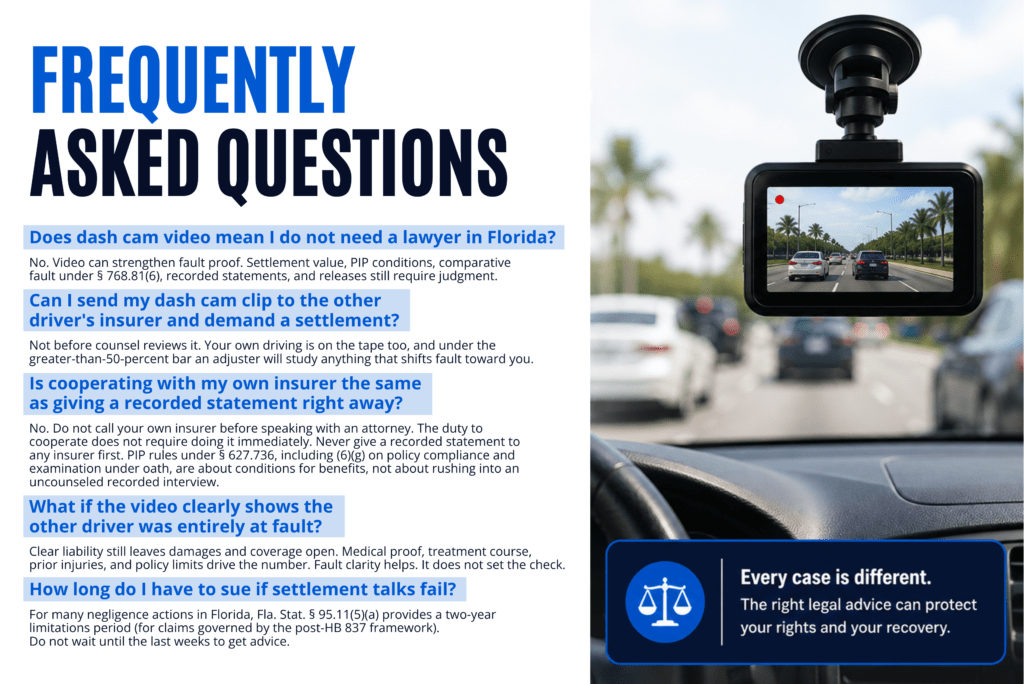
Does dash cam video mean I do not need a lawyer in Florida?
No. Video can strengthen fault proof. Settlement value, PIP conditions, comparative fault under § 768.81(6), recorded statements, and releases still require judgment.
Can I send my dash cam clip to the other driver’s insurer and demand a settlement?
Not before counsel reviews it. Your own driving is on the tape too, and under the greater-than-50-percent bar an adjuster will study anything that shifts fault toward you.
Is cooperating with my own insurer the same as giving a recorded statement right away?
No. Do not call your own insurer before speaking with an attorney. The duty to cooperate does not require doing it immediately. Never give a recorded statement to any insurer first. PIP rules under § 627.736, including (6)(g) on policy compliance and examination under oath, are about conditions for benefits, not about rushing into an uncounseled recorded interview.
What if the video clearly shows the other driver was entirely at fault?
Clear liability still leaves damages and coverage open. Medical proof, treatment course, prior injuries, and policy limits drive the number. Fault clarity helps. It does not set the check.
How long do I have to sue if settlement talks fail?
For many negligence actions in Florida, Fla. Stat. § 95.11(5)(a) provides a two-year limitations period (for claims governed by the post-HB 837 framework). Do not wait until the last weeks to get advice.
Talk before you settle
If you have dash cam footage from a Florida car accident and you are tempted to settle on your own, get a file review first. I can look at what the video shows, what it does not show, and whether a DIY path is exposing you on statements, PIP, or releases.
Call 561-561-DASH (3274). Consultations are free to start the conversation. Contingency fee: no fee unless I recover for you.
Serving Palm Beach County, including West Palm Beach, Palm Springs, Belle Glade, and nearby communities.
This article is general information, not legal advice. Reading it does not create an attorney-client relationship. Florida law and facts vary by case.
Looking for an accident Lawyer near you in Palm Beach County? Find Out What Your Case Is Worth - Free Consultation
Call us or complete the form below.
We'll keep your information confidential.
Palm Springs Office
Belle Glade Office
By appointment only