
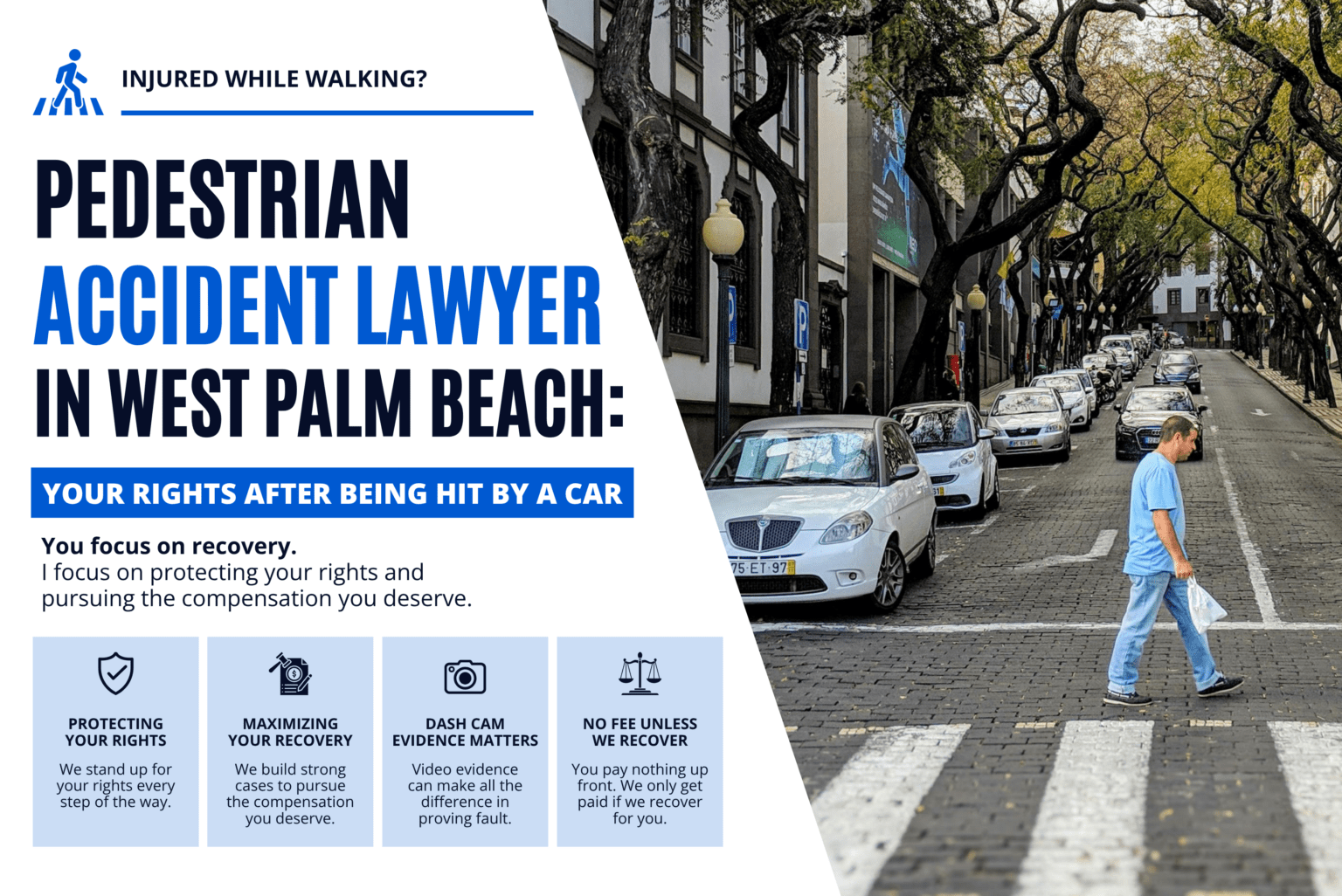
Pedestrian Accident Lawyer in West Palm Beach: Your Rights After Being Hit by a Car
By Shannon J. Sagan, Esq., The Dash Cam Lawyer®, Fla. Bar #10793
If a car hit you while you were walking in West Palm Beach, Florida personal injury protection benefits will most likely pay for a portion of your medical bills regardless of who caused the crash, but only if you get treated within 14 days. You can pursue the driver for pain and suffering if your injury is permanent. In most cases you have two years to file suit.
What to Do in the First Hours After a Pedestrian Crash
A pedestrian crash is different from a fender bender. You have no airbag, no crumple zone, and no seat belt. Injuries that look minor at the roadside, a bumped head, a sore hip, a numb hand, are often the ones that turn into permanent problems. What you do in the first hours shapes the claim.
- Call 911 and insist on a written crash report. A report creates the official record of where you were standing, which direction the vehicle came from, and what the driver said at the scene.
- Get examined within 14 days. Florida law cuts off personal injury protection benefits entirely if your first treatment comes later than 14 days after the crash. Section 627.736(1)(a), Florida Statutes. This single deadline destroys more pedestrian claims than any other rule in the no-fault system.
- Photograph everything before it changes. The crosswalk paint, the signal head and its timing, the streetlight, the vehicle’s resting position, the skid marks, the debris field, and your injuries. Weather and traffic erase a scene within hours.
- Collect witness names and hunt for video immediately. Other drivers stopped at the light may have dash cams. Palm Tran buses, delivery vans, gas stations, and nearby businesses often record the roadway. Most of those systems overwrite themselves in days.
- Do not call your own insurance company until you have spoken with an attorney about your rights. Almost everyone reaches for the phone from the scene out of instinct. That instinct costs people money. You do have an obligation under your policy to cooperate with your own insurer, and you should honor it, but nothing in that obligation requires you to do it in the first hour, or the first day, before you understand what your coverage actually is.
- Never give a recorded statement to the at-fault driver’s insurance company or to your own insurance company before you speak with an attorney. Adjusters are trained to ask questions that sound sympathetic and produce answers that reduce what they pay. A recorded statement given while you are medicated and frightened follows the claim to the end.
Who Pays Your Medical Bills When You Were on Foot
People are often surprised to learn that Florida’s no-fault system reaches them even though they were walking. It does. Personal injury protection follows the person, not just the car. It’s a point that the majority of my clients in these types of accidents do not understand, agree with, nor are they happy about it. And I don’t blame them.
Section 627.736, Florida Statutes, provides up to $10,000 in medical and disability benefits and $5,000 in death benefits, and it applies to a person struck by a motor vehicle who was not occupying a self-propelled vehicle at the time. That is the statutory description of a pedestrian. The order of priority runs like this:
- If you own a vehicle that has to be insured in Florida, your own auto policy pays first, even though your car was parked at home.
- If you do not own such a vehicle but you live with a relative who does, that relative’s policy pays. If more than one resident relative has coverage, the carriers share it pro rata, and the total is still capped at the policy limit.
- If neither applies, the personal injury protection coverage of the owner or operator of the vehicle that struck you pays.
One important limit: these provisions do not apply if the crash happened outside Florida.
You may also have read that Florida ended no-fault coverage. It did not. Senate Bill 522 and House Bill 769 both died in committee on March 13, 2026, and the $10,000 requirement and the 14-day rule are still the law in August 2026. Stale articles and AI generated summaries keep recycling the repeal story, and people skip treatment because of it.
When You Can Pursue the Driver for Pain and Suffering
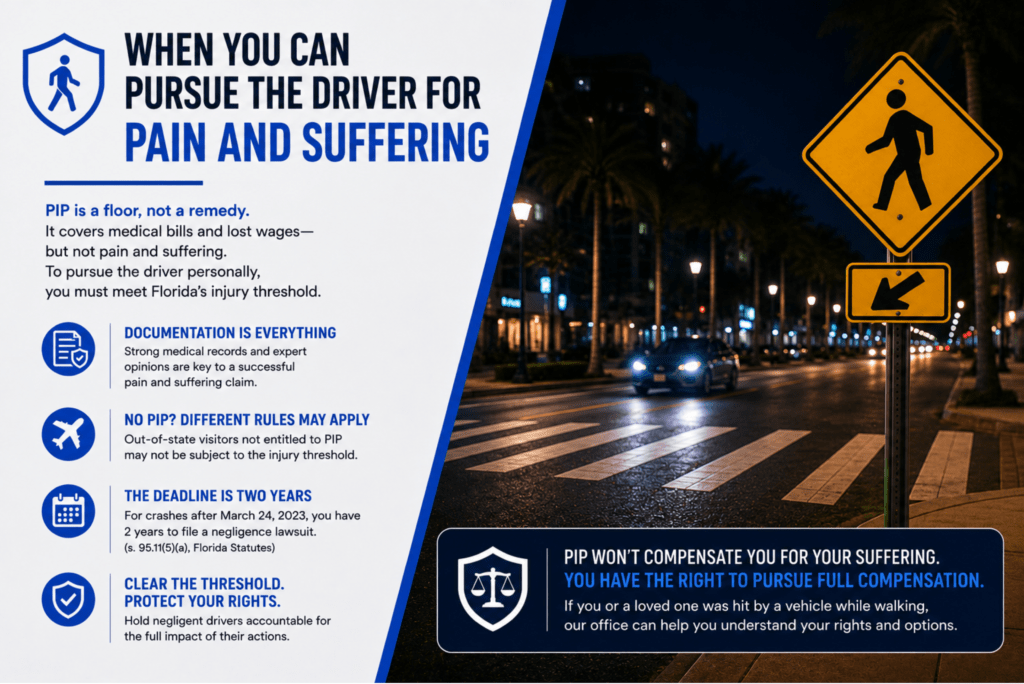
Personal injury protection is a floor, not a remedy. It pays 80 percent of reasonable medical expenses and 60 percent of lost wages up to the limit, and it pays nothing at all for what the injury did to your life. To reach the driver’s own pocket for pain and suffering, Florida requires you to clear the injury threshold in section 627.737(2), Florida Statutes.
The threshold is met if the injury consists in whole or in part of:
- Significant and permanent loss of an important bodily function.
- Permanent injury within a reasonable degree of medical probability, other than scarring or disfigurement.
- Significant and permanent scarring or disfigurement.
- Death.
In pedestrian cases the threshold is usually the least of your problems, because the forces involved produce fractures, joint damage, traumatic brain injury, and surgical scarring. What matters is documentation: an orthopedist or neurologist willing to state permanency to a reasonable degree of medical probability, supported by imaging and a consistent treatment record.
There is a wrinkle worth knowing. A person who is not entitled to personal injury protection benefits at all, such as an out-of-state visitor struck while walking in Palm Beach County, may not be held to the threshold in the first place. If you were visiting Florida when this happened, that changes the analysis and it is worth raising early.
The filing deadline is short. For crashes occurring after March 24, 2023, a negligence action must be filed within two years. Section 95.11(5)(a), Florida Statutes. Two years sounds generous while you are in a cast. It is not.
Proving the Driver Was at Fault
Drivers and their insurers have one reflex in pedestrian cases: blame the pedestrian. “He stepped out in front of me.” “She was on her phone.” “It was dark.” Florida’s traffic code gives you a great deal to work with in response.
Section 316.130, Florida Statutes, sets the rules. Where a traffic signal controls the intersection, a driver must stop before the crosswalk and stay stopped for a pedestrian crossing with a permitted signal on the driver’s half of the road, or approaching closely enough from the other half to be in danger. Where no signal is in place or operating, the driver must yield the right of way, slowing or stopping if necessary, to a pedestrian in the crosswalk under those same conditions. The statute also requires every driver to exercise due care to avoid colliding with a pedestrian and to give warning when needed.
Pedestrians have duties too. If you crossed somewhere other than a marked crosswalk, or other than an unmarked crosswalk at an intersection, you were required to yield to vehicles. That fact does not end your claim, and I explain why in the comparative negligence section below.
Video is what turns a swearing contest into a documented case. In a pedestrian crash the useful footage almost never comes from your own camera, it comes from the vehicles around the collision, and that is exactly the evidence I chase first. Two Florida rules govern it. Section 90.901, Florida Statutes, requires that video be authenticated before it goes in front of a jury, which usually means testimony from someone with knowledge of the recording and an unbroken chain of custody. Section 934.03, Florida Statutes, is Florida’s all-party consent rule for recorded conversations, which is why audio, not video, is the part of a dash cam file that occasionally creates a problem.
The practical issue is time. Business surveillance systems commonly overwrite in seven to thirty days. Consumer dash cams loop far faster than that. A preservation letter sent in week one is worth more than a subpoena sent in month three.
How Comparative Negligence Affects a Pedestrian Claim
Since House Bill 837 took effect in 2023, Florida uses modified comparative negligence. Under section 768.81, Florida Statutes, a claimant who is found more than 50 percent at fault recovers nothing. At 50 percent or less, your recovery is reduced by your share.
Read that carefully, because insurers describe it inaccurately on purpose. Crossing mid-block does not automatically bar your claim. A driver who was speeding, distracted, or turning without looking can still carry the majority of the fault. The fight in most pedestrian cases is about where the percentage lands, and percentages move based on evidence, signal timing data, lighting conditions, vehicle speed from event data recorders, and video.
If the Driver Fled or Had No Insurance
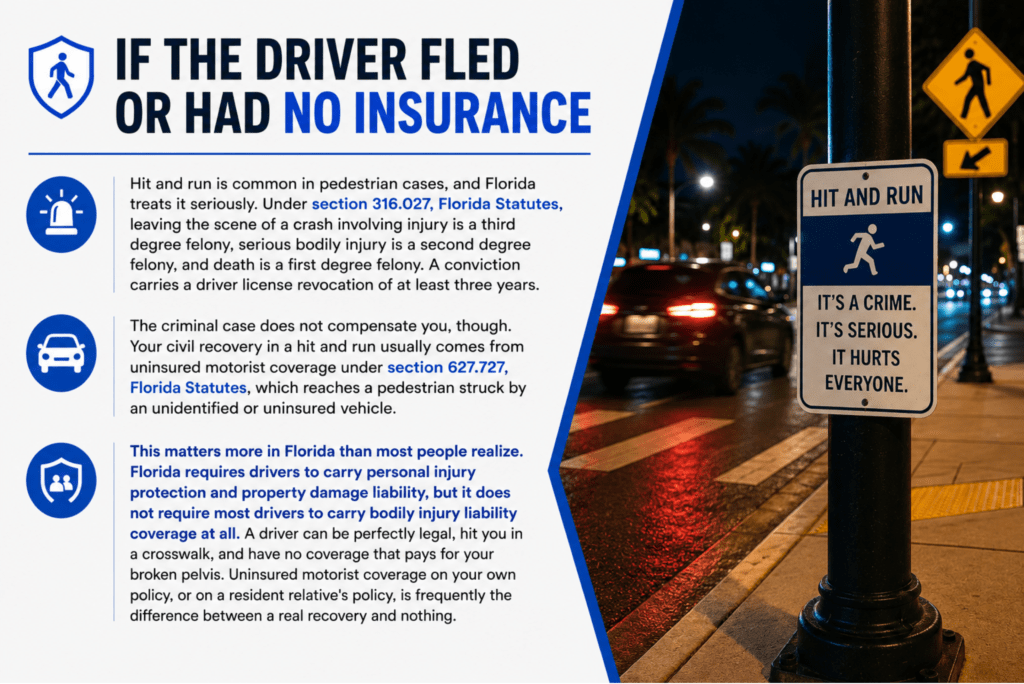
Hit and run is common in pedestrian cases, and Florida treats it seriously. Under section 316.027, Florida Statutes, leaving the scene of a crash involving injury is a third degree felony, serious bodily injury is a second degree felony, and death is a first degree felony. A conviction carries a driver license revocation of at least three years.
The criminal case does not compensate you, though. Your civil recovery in a hit and run usually comes from uninsured motorist coverage under section 627.727, Florida Statutes, which reaches a pedestrian struck by an unidentified or uninsured vehicle.
This matters more in Florida than most people realize. Florida requires drivers to carry personal injury protection and property damage liability, but it does not require most drivers to carry bodily injury liability coverage at all. A driver can be perfectly legal, hit you in a crosswalk, and have no coverage that pays for your broken pelvis. Uninsured motorist coverage on your own policy, or on a resident relative’s policy, is frequently the difference between a real recovery and nothing.
Why Pedestrian Crashes Keep Rising in Palm Beach County
Palm Beach County’s road design is hostile to people on foot in ways that show up in the crash data. Six lane arterials with signals spaced far apart, such as Okeechobee Boulevard, Southern Boulevard, Military Trail, Blue Heron Boulevard, and US 1, invite mid-block crossings because the nearest legal crossing is a quarter mile away. Add seasonal traffic, early sunset in winter, and workers walking to jobs along corridors built only for cars, and the pattern repeats itself.
Preliminary state crash data for 2025 indicates several hundred pedestrian crashes and dozens of pedestrian deaths in Palm Beach County, and the county’s share of Florida’s pedestrian crashes has grown in recent years. Belle Glade and the western communities carry a share of that burden well out of proportion to their population, which is one reason my office keeps a location out there.
Frequently Asked Questions
What does a pedestrian accident attorney in West Palm Beach actually do?
I identify every layer of available coverage, which in a pedestrian case usually means your personal injury protection, the driver’s liability policy if one exists, and uninsured motorist coverage. I send preservation letters to businesses and vehicle owners before the video is overwritten. I build the permanency proof needed to clear the injury threshold, and I handle the insurers so you are not giving statements while you are recovering.
I was hit by a car while walking in Palm Beach County. Who pays my medical bills?
Your own auto policy pays first if you own an insured vehicle, even though you were on foot. If you do not, a resident relative’s policy applies. If neither exists, the personal injury protection coverage on the vehicle that struck you applies. All of it depends on getting treatment within 14 days.
Do pedestrians always have the right of way in Florida?
No. Drivers must yield to pedestrians in crosswalks under section 316.130, Florida Statutes, and must exercise due care generally. But a pedestrian crossing outside a crosswalk must yield to vehicles. Being partly at fault reduces recovery, it does not eliminate it, unless your share exceeds 50 percent.
How long do I have to file a pedestrian injury claim in Florida?
For crashes after March 24, 2023, the deadline for a negligence lawsuit is two years under section 95.11(5)(a), Florida Statutes. Insurance notice deadlines and the 14-day treatment rule arrive much sooner, so waiting is expensive.
Should I give a recorded statement to the insurance company?
Not before you talk with an attorney. That applies to the at-fault driver’s insurer and to your own. You do have a duty to cooperate with your own carrier under the policy, but that duty does not require you to give a recorded statement immediately, before you know what your coverage is or how serious your injury is.
What if the driver who hit me left the scene?
Report it immediately and get the crash report. Leaving the scene of a crash involving injury is a felony under section 316.027, Florida Statutes. For your compensation, uninsured motorist coverage under section 627.727 typically applies to a hit and run pedestrian claim, and video from nearby vehicles and businesses is often what identifies the car.
Is dash cam video from another driver useful if I was the pedestrian?
Very. In pedestrian cases the camera is almost always in somebody else’s windshield. Footage from a vehicle stopped at the light shows signal phase, vehicle speed, and where you were in the roadway. It has to be authenticated under section 90.901, Florida Statutes, and it has to be requested before the loop erases it.
What does it cost to hire you for a pedestrian accident case?
Nothing up front. I handle pedestrian injury claims on a contingency fee, which means no fee unless I recover for you. The consultation is free.
Talk With My Office About Your Pedestrian Injury Claim
If a vehicle hit you or a family member while walking anywhere in Palm Beach County, from downtown West Palm Beach to Lake Worth Beach, Riviera Beach, Boynton Beach, Wellington, or Belle Glade, I offer a free consultation and there is no fee unless I recover for you.
Call 561-561-DASH (3274). My team speaks Spanish. If anyone recorded the crash, tell me on the first call, because preserving that video is the most time sensitive thing in your case.
Disclaimer: This article is general information about Florida law, not legal advice, and reading it does not create an attorney client relationship. Every case turns on its own facts. Statutes and case law change. For advice about your situation, speak with a licensed Florida attorney.

Looking for an accident Lawyer near you in Palm Beach County? Find Out What Your Case Is Worth - Free Consultation
Call us or complete the form below.
We'll keep your information confidential.
Palm Springs Office
Belle Glade Office
By appointment only