
Florida’s Cheapest Legal Car Policy Could Leave Your Family Paying the Bills
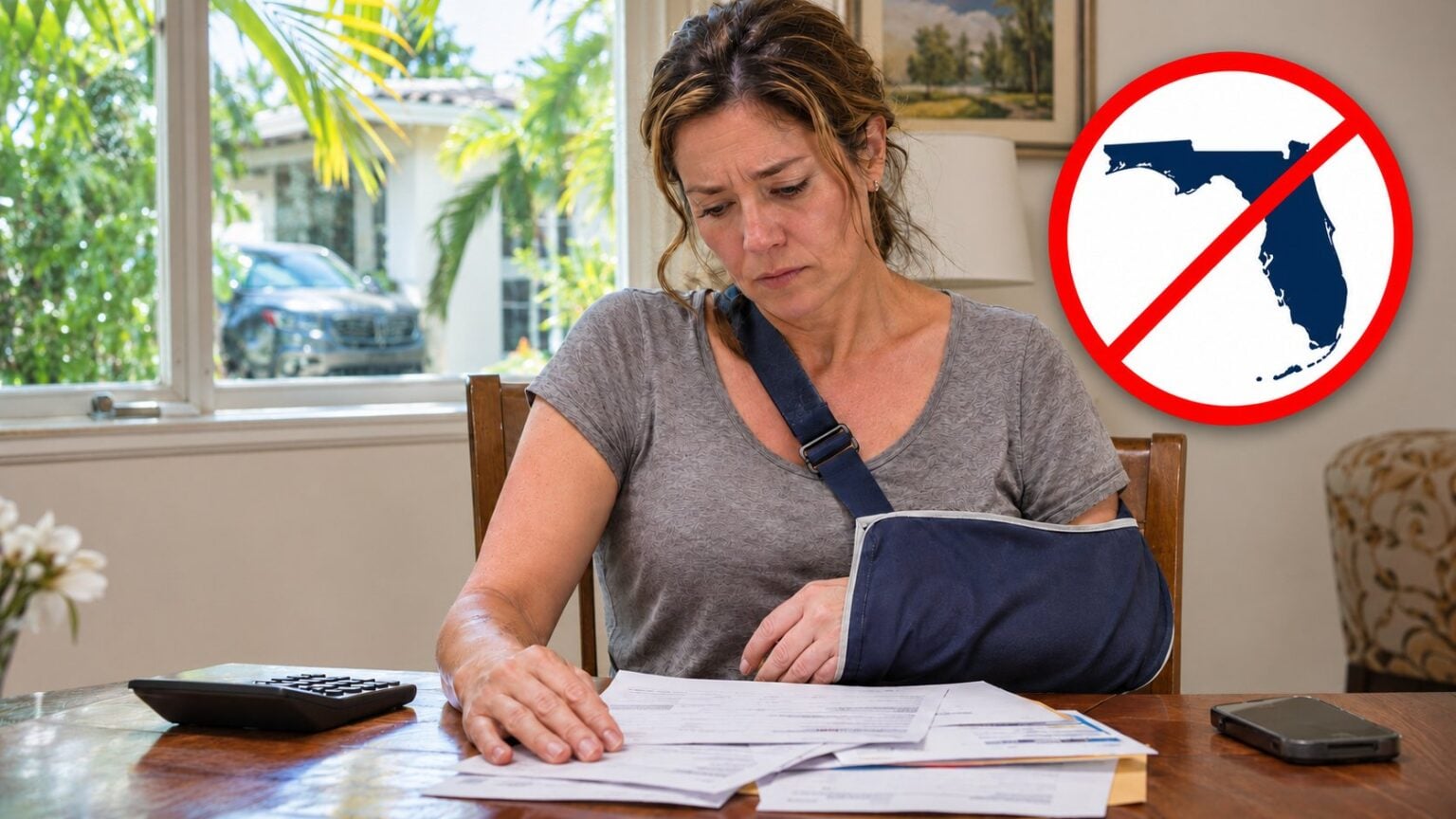
Here’s some good news for once: Florida auto insurance rates are coming down, slightly. The Florida Office of Insurance Regulation (OIR) says the state’s five largest auto insurance groups, which cover about 78% of the market, are averaging an 8% rate cut for 2026, following a 7.4% cut in 2025.
Money is still tight for a lot of families, though. When the renewal arrives, it’s tempting to call your agent and ask for “the cheapest legal policy.” In Florida, that request has consequences most people don’t think about until they’re sitting in an emergency room.
This post explains what Florida’s minimum policy actually covers, what it leaves out, and how to check your own policy in about a minute.
What Florida actually requires
To register a car in Florida, you need two coverages:
- $10,000 in personal injury protection (PIP), which pays for your own injuries no matter who caused the crash (Fla. Stat. §627.736).
- $10,000 in property damage liability (PDL), which pays for damage you cause to someone else’s property (Fla. Stat. §324.022).
That’s it. Notice what is missing: bodily injury (BI) liability, the coverage that pays when you injure someone else.
According to the Insurance Information Institute, Florida’s compulsory insurance law applies to PIP and property damage, “but not to third party bodily injury coverage.” That makes Florida the only state that requires drivers to buy insurance but leaves bodily injury out of the requirement. New Hampshire is the only other state with no BI mandate, and it requires no insurance at all; instead, drivers there must be able to prove they can pay for damage they cause. Virginia used to let drivers pay a fee instead of buying insurance, but that option ended on July 1, 2024.
What PIP really pays
PIP is often described as “no-fault” coverage, and many drivers assume it takes care of everything. It doesn’t:
- PIP works a lot like health insurance. It pays 80% of reasonable medical expenses, not 100%.
- PIP is capped at $2,500 unless a doctor finds an emergency medical condition, which can then raise it to up to $10,000 in medical care.
- Treatment generally has to begin within 14 days of the crash.
- PIP pays nothing for pain and suffering.
A serious injury can exceed $10,000 quickly. After PIP runs out, the bills go to your health insurance (with its deductibles and copays, and a lot of people don’t have health insurance at all) or to you, unless you have uninsured motorist coverage.
The hidden catch: a minimum policy can’t carry UM
Uninsured motorist (UM) coverage protects you and your family when the driver who hurts you has no bodily injury coverage, not enough of it, or drives away. In my view, it’s the most important coverage you can have on your auto policy. It acts as a backup when an at-fault driver who is uninsured or underinsured injures you.
Under Fla. Stat. §627.727, a policy that includes bodily injury liability must also include UM unless you reject it in writing. A policy that carries only the required PIP and property damage has no bodily injury coverage, so it carries no UM at all.
So when a driver cuts down to the state minimum, they lose protection in both directions:
- If they hurt someone, they have no bodily injury coverage to pay that person’s claim, and they run the risk of their insurance company not providing them a lawyer if they’re sued.
- If they are hurt by an uninsured, underinsured, or hit-and-run driver, they have no UM to fall back on.
Who else is on the road with you
The gap matters because of the numbers:
- About 1 in 5 Florida drivers is uninsured. The Insurance Research Council (IRC) estimates 20.6% of Florida drivers were uninsured in 2023, the 7th-highest rate among 51 jurisdictions (the 50 states plus D.C.). The national rate was 15.4%.
- About 1 in 4 Florida crashes is a hit-and-run. The Florida Department of Highway Safety and Motor Vehicles (FLHSMV) reported 97,519 hit-and-run crashes in 2024.
- About half of Florida policyholders buy UM. The Florida Policy Project, using 2020 NAIC data, found that roughly 52% of Florida policyholders bought UM/UIM coverage. That means roughly half did not.
The IRC’s uninsured figure is an estimate built from insurance claim data. It counts drivers with no insurance at all; it doesn’t count drivers who carry only PIP and property damage.
What I see in my own cases
In 2026, about 40% of the at-fault drivers who hit and injured my clients were uninsured or had $0 bodily injury coverage.
In my over 25 years of being in this industry, I’ve never seen it this bad. It’s becoming a huge problem because at-fault drivers are injuring people, putting them in the hospital, and the injured party is left to figure out how to pay their bills and get further medical care. It is very difficult for me to tell an injured client (let alone 40% of them now) that I cannot help after they were injured by an underinsured driver.
One of the most heart-wrenching cases was when I had to tell the mother of a 17-year-old whose leg was amputated in an accident that was not his fault that there was no injury coverage to collect from the other driver. I even spoke with two other colleagues to try and find ANY angle or way to help this young man, but I could not find one. It really had me upset, angry, and disappointed that Florida still has this system.
“Can’t I just sue the other driver?”
You can, and the at-fault driver doesn’t walk away untouched. Under Chapter 324 of the Florida Statutes, the state can suspend the license and registration of an owner or driver who didn’t carry the required liability coverage after a reported crash, and an unpaid court judgment can lead to another suspension until it is paid or a payment plan is in place.
You can also win a judgment, and it can last for years. But with no bodily injury coverage there is often no insurance company to pay it, and Florida law shields many debtors’ income from collection. For example, a head of family’s disposable earnings of $750 a week or less are exempt from garnishment (Fla. Stat. §222.11). Many at-fault drivers simply have nothing to collect, and it can be difficult to even find a lawyer who would pursue it.
Bottom line: Trying to save money and getting the bare minimum gets you a license plate. It doesn’t provide your family with a safety net. You could get a judgment, but with no BI there’s often no way to collect. Your medical bills land on your PIP, your health insurance (if you have it), or your UM, if you bought it.
Lawmakers have tried to fix this
In 2021, the Florida Legislature passed CS/CS/SB 54, which would have repealed PIP and required bodily injury coverage. It cleared the Senate 37-3 and the House 100-16. Gov. Ron DeSantis vetoed it on June 29, 2021, citing “unintended consequences.” Similar bills to replace no-fault and require bodily injury coverage died in 2025 (HB 1181 and SB 1256) and again in 2026 (SB 522 and HB 769).
For now, the protection your family has is the protection you choose to buy. Rates are slightly coming down, so if your renewal is lower this year, don’t spend the savings by cutting coverage. Spend 60 seconds reading your declarations page instead.
Your 60-second policy check
Open your insurer’s app or your latest renewal email and find the declarations page. Then check:
- Bodily injury liability. Is there a dollar amount listed? If it says “none” or isn’t there, you run the risk of your insurance company not providing you a lawyer if you injure someone and are sued. You also can’t have UM coverage without BI coverage.
- Uninsured/underinsured motorist (UM/UIM). Is it listed, or did you sign a form rejecting it?
- Every vehicle and driver. Check the second car, the teen driver, and anyone on a separate policy.
- Get a real quote. Ask your agent what it would cost to add or raise BI and UM, and compare that with what you’re saving at renewal this year.
- Document the road. A dash cam can help capture what happened and, in a hit-and-run, details like the other vehicle and plate. It’s why I’ve given away more than 1,400 dash cams for free to Florida drivers.
If you are hurt in a crash, protect your claim
- Don’t call your own insurance company before you speak with an attorney.
- Your policy’s duty to cooperate doesn’t require you to do it immediately. You can talk with a lawyer first.
- Never give a recorded statement to any insurer, yours or the other driver’s, before you speak with an attorney.
Frequently asked questions
Is Florida the only state that doesn’t require bodily injury coverage?
Florida is the only state that requires car insurance but doesn’t require bodily injury liability as part of it. New Hampshire doesn’t require insurance at all, but drivers must be able to show they can pay damages they cause.
Does “full coverage” include uninsured motorist coverage?
Not necessarily. “Full coverage” isn’t a legal term in Florida. UM is a separate, optional coverage that you can reject in writing (Fla. Stat. §627.727). The only way to know is to check your declarations page.
If I only have PIP and property damage, can I add UM by itself?
Under §627.727, UM is tied to policies that include bodily injury liability. A PIP-and-property-damage-only policy doesn’t carry UM. Ask your agent about adding both.
What happens if a hit-and-run driver injures me?
Your own PIP pays 80% of your reasonable medical bills, up to $10,000 if a doctor finds an emergency medical condition (otherwise $2,500). Beyond that, UM is often the only coverage that pays for your injuries when the other driver can’t be found. Report the crash to police right away and seek medical treatment within 14 days.
Are Florida car insurance rates going up?
For most policyholders, no. OIR reported an average 8% cut among the top five auto insurance groups for 2026, after a 7.4% cut in 2025, and said nearly 80% of policyholders are seeing lower rates.
Does the at-fault driver face any consequences if they had no bodily injury coverage?
Yes. Florida can suspend their license and registration, and you can sue and win a judgment. The challenge is collecting: without insurance, there is often no one to pay.
If a driver with little or no insurance hurt you or someone in your family, call me at 561-561-DASH (3274) for a free consultation. No fee unless I recover for you. No recovery, no fees or costs.
This article is from The Dash Cam Lawyer® and is general information, not legal advice. Every policy and every crash is different; talk with your insurance agent about your coverage.
Sources
- Insurance Information Institute, “Facts + Statistics: Uninsured motorists.” https://www.iii.org/fact-statistic/facts-statistics-uninsured-motorists
- Insurance Research Council, news release, Feb. 17, 2025 (New Hampshire financial responsibility). https://insurance-research.org/news/one-three-drivers-are-either-uninsured-or-underinsured-us-exposing-themselves-and-other
- Insurance Research Council, “Uninsured and Underinsured Motorists: 2017 to 2023.” https://insurance-research.org/uninsured-motorists/uninsured-and-underinsured-motorists-2017-2023
- Virginia DMV, “New Laws Take Effect Today,” July 1, 2024. https://www.dmv.virginia.gov/news/new-laws-take-effect-today-july-1-2024
- FLHSMV, Insurance requirements. https://www.flhsmv.gov/insurance/
- Fla. Stat. §627.736 (PIP). https://www.leg.state.fl.us/statutes/index.cfm?App_mode=Display_Statute&URL=0600-0699/0627/Sections/0627.736.html
- Fla. Stat. §324.022 (property damage liability). https://www.leg.state.fl.us/statutes/index.cfm?App_mode=Display_Statute&URL=0300-0399/0324/Sections/0324.022.html
- Fla. Stat. §627.727 (uninsured motorist coverage). https://www.leg.state.fl.us/statutes/index.cfm?App_mode=Display_Statute&URL=0600-0699/0627/Sections/0627.727.html
- Fla. Stat. Chapter 324 (financial responsibility). https://www.leg.state.fl.us/statutes/index.cfm?App_mode=Display_Statute&URL=0300-0399/0324/0324.html
- Fla. Stat. §222.11 (wage garnishment exemption). https://www.leg.state.fl.us/statutes/index.cfm?App_mode=Display_Statute&URL=0200-0299/0222/Sections/0222.11.html
- FLHSMV, “Should I Stay or Should I Go? The Fear Factor Behind Hit-and-Run Crashes,” Feb. 3, 2025. https://www.flhsmv.gov/2025/02/03/should-i-stay-or-should-i-go-the-fear-factor-behind-hit-and-run-crashes/
- FLHSMV, Hit-and-run safety page. https://www.flhsmv.gov/safety-center/driving-safety/hitrun/
- Florida Policy Project, auto insurance reform report (June 2025). https://floridapolicyproject.org/assets/research/reports/fppautoinsurancereformreport-88c2d4f7.pdf
- Florida OIR, news release, March 5, 2026. https://floir.gov/newsroom/archives/item-details/2026/03/05/commissioner-mike-yaworsky-announces-more-significant-auto-rate-decreases-for-florida-s-top-5-auto-insurance-groups
- Florida Senate, CS/CS/SB 54 (2021). https://www.flsenate.gov/Session/Bill/2021/00054 ; Governor’s veto letter. https://www.flgov.com/eog/sites/default/files/press/SB-54-Transmittal-Letter.pdf
- Florida Senate, HB 1181 (2025) https://www.flsenate.gov/Session/Bill/2025/1181 ; SB 1256 (2025) https://www.flsenate.gov/Session/Bill/2025/1256 ; SB 522 (2026) https://www.flsenate.gov/Session/Bill/2026/522 ; Florida House, HB 769 (2026) https://www.flhouse.gov/Sections/Bills/billsdetail.aspx?BillId=83408

Looking for an accident Lawyer near you in Palm Beach County? Find Out What Your Case Is Worth - Free Consultation
Call us or complete the form below.
We'll keep your information confidential.
Palm Springs Office
Belle Glade Office
By appointment only