
Hit by a Drunk Driver in Palm Beach County: Your Legal Options
By Shannon J. Sagan, Florida Bar No. 10793, The Dash Cam Lawyer®
If a drunk driver hit you in Palm Beach County, your injury claim is a separate case from the criminal DUI prosecution, and it moves on its own timeline. Florida law removes the usual cap on punitive damages when the at fault driver was impaired. Get medical care within 14 days, save the evidence immediately, and speak with a lawyer before you call any insurance company.
A Drunk Driving Crash Is Not Just Another Car Accident
Most car accident claims turn on one question: who was careless. A crash caused by an impaired driver adds layers an ordinary rear-end collision does not have. There is a parallel criminal case on its own schedule. There is evidence that exists only because law enforcement gathered it, including field sobriety results and breath or blood testing. There may be a third party, such as a bar, whose records disappear within days. And Florida law treats impaired drivers differently on punitive damages.
The Criminal DUI Case and Your Injury Claim Are Two Different Cases
Driving under the influence is a crime under Florida Statute section 316.193. The State Attorney prosecutes that case. You are a witness in it, not a party, and you do not control whether charges are filed, reduced, or dropped.
Your injury claim is a civil case, and you control it. A criminal conviction requires proof beyond a reasonable doubt. A civil injury claim requires only the greater weight of the evidence. That gap matters: a driver can be acquitted or have charges dropped and still be liable to you.
Criminal courts can order restitution under Florida Statute section 775.089, enforceable like a civil judgment. Restitution is useful but narrow. It targets direct economic loss and does not compensate pain or permanent injury, so it is not a substitute for evaluating a civil claim.
The criminal case timeline does not extend your civil deadline. Waiting for the DUI case to resolve before looking at your own claim is a common and expensive mistake.
Punitive Damages: Where Florida Law Treats Impaired Drivers Differently
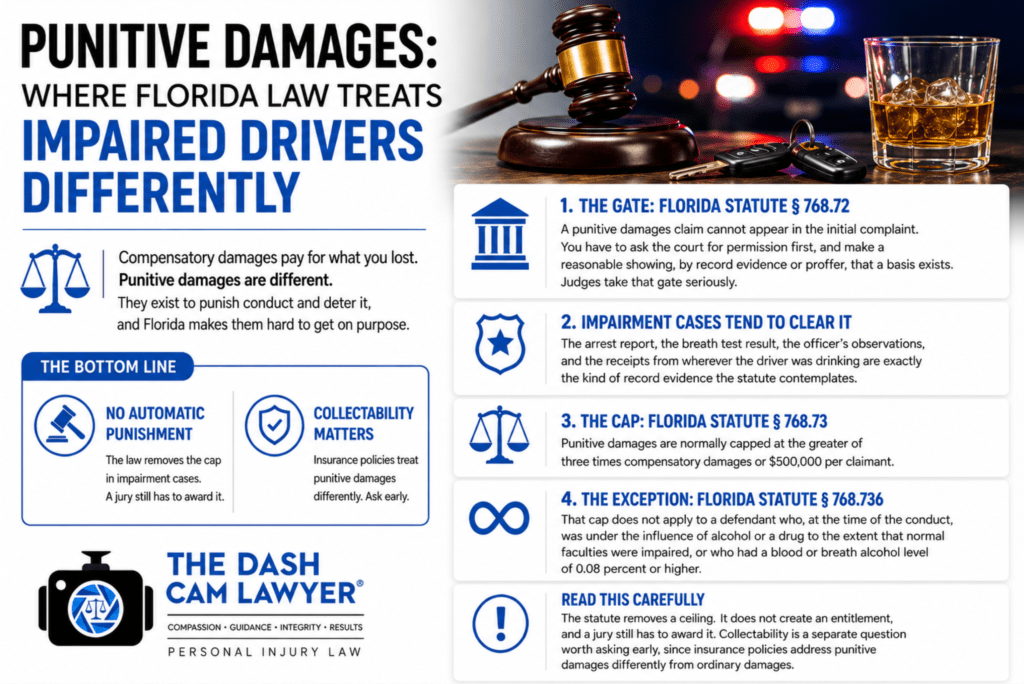
Compensatory damages pay for what you lost. Punitive damages are different. They exist to punish conduct and deter it, and Florida makes them hard to get on purpose.
Florida Statute section 768.72 sets the gate. A punitive damages claim cannot appear in the initial complaint. You have to ask the court for permission first, and make a reasonable showing, by record evidence or proffer, that a basis exists. Judges take that gate seriously.
Impairment cases tend to clear it. The arrest report, the breath test result, the officer’s observations, and the receipts from wherever the driver was drinking are exactly the kind of record evidence the statute contemplates.
Then comes the part that makes these cases distinct. Florida Statute section 768.73 normally caps punitive damages at the greater of three times compensatory damages or $500,000 per claimant. Florida Statute section 768.736 says that cap does not apply to a defendant who, at the time of the conduct, was under the influence of alcohol or a drug to the extent that normal faculties were impaired, or who had a blood or breath alcohol level of 0.08 percent or higher.
Read that carefully, because the point is often overstated online. The statute removes a ceiling. It does not create an entitlement, and a jury still has to award it. Collectability is a separate question worth asking early, since insurance policies address punitive damages differently from ordinary damages.
Someone Other Than the Driver May Share Responsibility
Florida is one of the more protective states in the country for businesses that sell alcohol. Under Florida Statute section 768.125, a person or business that sells or furnishes alcohol to someone of lawful drinking age is generally not liable for what that person does afterward.
There are two narrow exceptions written into the statute:
- Knowingly selling or furnishing alcohol to a person who is not lawfully permitted to drink, which in Florida means someone under 21.
- Knowingly selling or furnishing alcohol to a person known to be habitually addicted to alcohol.
Both exceptions turn on the word knowingly, and proving knowledge takes documents like point of sale records, tab receipts, server statements, identification scans, and surveillance video. Venue camera systems commonly overwrite within days. If a bar may be involved, a preservation letter needs to go out fast.
Separately, if the impaired driver was working at the time, whether making deliveries, driving a company vehicle, or running an errand for an employer, the employer may carry responsibility and, just as importantly, larger insurance limits.
When the Drunk Driver Has Little or No Insurance
This is the outcome nobody expects and many people face. Florida does not require most private drivers to carry bodily injury liability coverage. A driver can be fully legal with personal injury protection and property damage liability only, meaning no bodily injury liability coverage stands behind the person who hurt you.
Uninsured and underinsured motorist coverage under Florida Statute section 627.727 is what fills that hole, and it comes from your own auto policy. If you carry it, it can apply when the at fault driver has no coverage or not enough of it. Whether your coverage is stacked or unstacked changes the math significantly, and most people do not know which they bought.
Personal Injury Protection Still Applies, and the 14-Day Rule Still Matters
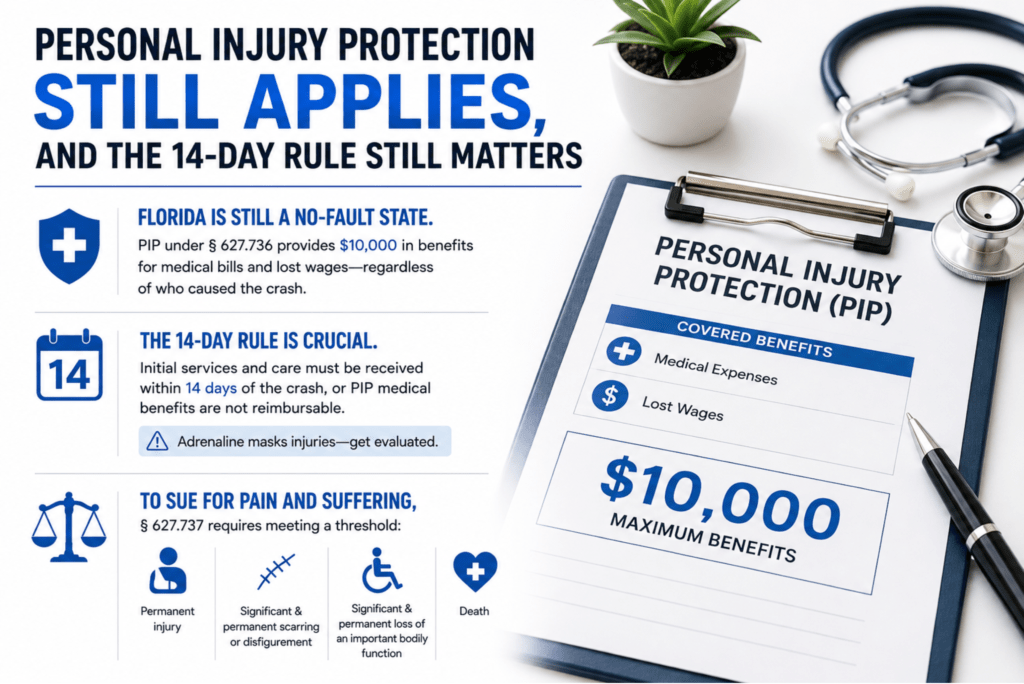
Florida remains a no-fault state. Personal injury protection under Florida Statute section 627.736 provides $10,000 in benefits regardless of who caused the crash, and it pays a percentage of medical bills and lost wages up to that limit.
The rule that catches people is the deadline. Initial services and care must be received within 14 days of the crash, or personal injury protection medical benefits are not reimbursable at all. Adrenaline masks injuries, so people who walk away feeling fine often feel very different three days later. Get evaluated.
To pursue compensation for pain and suffering against the at fault driver, Florida Statute section 627.737 requires meeting a threshold, which generally means a permanent injury, significant and permanent scarring or disfigurement, significant and permanent loss of an important bodily function, or death.
What to Do After a Crash With a Suspected Impaired Driver
- Call 911 and ask for both law enforcement and medical response. Say what you observed about the other driver. Slurred speech, the smell of alcohol, and unsteady movement belong in the dispatch recording, which is preserved.
- Do not confront the other driver. An impaired person is unpredictable, and a confrontation can undermine an otherwise clean case.
- Identify witnesses before they leave. Get names and phone numbers. Witnesses who saw the driving pattern before impact matter far more than those who arrived after.
- Photograph everything: vehicle positions, damage, skid marks, debris, road conditions, and any open containers visible in plain view. Do not reach into the other vehicle.
- Save your dash cam footage the same day. Most units loop and overwrite. Pull the memory card or lock the clip immediately.
- Get medical care within 14 days, and preferably within 48 hours. This protects both your health and your personal injury protection benefits.
- Do not call your own insurance company until you have spoken with an attorney about your rights. Almost everyone reaches for the phone from the scene out of instinct. You do have an obligation to cooperate with your own insurer under your policy, but that obligation does not require you to do it immediately, and it does not require you to do it without advice.
- Never give a recorded statement to the at fault driver’s insurance company, and never give one to your own insurance company, before speaking with an attorney. Recorded statements are taken early for a reason. What sounds like a friendly conversation becomes a transcript, and casual phrases such as “I’m fine” or “I didn’t see him” get quoted back months later.
- Write down what you remember while it is fresh, including the sequence of events, what the other driver said, and the responding officers’ names. Then request the crash report.
The Deadlines That Can End a Claim Before It Starts
For crashes on or after March 24, 2023, the statute of limitations for negligence in Florida is two years, at Florida Statute section 95.11(5)(a).
Florida also applies modified comparative negligence under Florida Statute section 768.81. Your recovery is reduced by your share of fault, and if you are found more than 50 percent at fault, you recover nothing. Insurers know this rule and build arguments around it, which is another reason recorded statements matter.
How Dash Cam Footage Changes an Impaired Driving Case
Impairment cases are won on the driving pattern, not just the impact. A camera that captured the other car weaving across the lane line, drifting through a stop sign, traveling the wrong way, or never touching the brakes tells a story that no adjuster can argue away. That footage also protects you against the comparative fault argument, because it shows what you were doing in the seconds before the crash.
Two practical notes on Florida law. Authentication is governed by Florida Statute section 90.901, which requires evidence sufficient to support a finding that the recording is what it is claimed to be. That is straightforward when the original file, its metadata, and the device are preserved, and harder once clips have been re-saved or texted around.
Audio is a separate question. Florida Statute section 934.03 requires the consent of all parties to record a private conversation. Recording the roadway in front of your vehicle is not the concern. In-cabin audio can be, particularly with passengers who have a reasonable expectation of privacy. Know what your camera is capturing.
Frequently Asked Questions
Do I need a lawyer if the drunk driver was already arrested?
An arrest is helpful evidence, but it does not advance your injury claim. The prosecutor represents the state, not you, and the criminal case does not pursue compensation beyond limited restitution. Your civil claim runs on its own two-year clock, and third-party evidence such as bar or employer records disappears quickly.
How long do I have to file a claim after a drunk driving crash in Florida?
Two years from the date of the crash for negligence claims arising on or after March 24, 2023, under Florida Statute section 95.11(5)(a). Certain claims, such as wrongful death or claims involving a government vehicle, follow different rules and shorter notice requirements, so confirm the date for your specific facts.
Can I recover punitive damages from a drunk driver in Florida?
It is possible. Florida Statute section 768.72 requires court permission before punitive damages can be pleaded, supported by record evidence or a proffer. If the driver’s normal faculties were impaired, or the blood or breath alcohol level was 0.08 percent or higher, Florida Statute section 768.736 removes the cap that would otherwise apply. Removing a cap is not the same as receiving an award. A jury still decides.
What happens if the drunk driver had no insurance?
Uninsured and underinsured motorist coverage on your own policy, under Florida Statute section 627.727, is usually the answer. Florida does not require most drivers to carry bodily injury liability coverage, so this is common. Whether your coverage is stacked or unstacked affects the limits. Your personal injury protection benefits apply as well, subject to the 14-day rule.
Should I give a recorded statement to the insurance company?
Not before you have legal advice, and that applies to your own insurance company as well as the other driver’s. Your policy obligates you to cooperate with your insurer, but cooperating does not mean doing it immediately or unadvised. Recorded statements are requested early because early answers are incomplete, and they are quoted later.
Can I bring a claim against the bar that served the driver?
Only in narrow circumstances. Florida Statute section 768.125 generally shields businesses that serve alcohol to adults of lawful drinking age. Liability attaches where the business knowingly served someone under 21, or knowingly served a person known to be habitually addicted to alcohol. Proving knowledge depends on records and video that are routinely overwritten, so timing drives whether this claim is available at all.
How much does a drunk driving injury lawyer cost in Palm Beach County?
I handle these cases on a contingency fee. There is no fee for the consultation, no fee up front, and no fee unless I recover for you. The fee agreement is written out and explained before anything is signed.
How long do dash cams save footage after an accident?
Most consumer dash cams use loop recording and overwrite the oldest files continuously. On a typical 32 gigabyte to 64 gigabyte card recording in high definition, that cycle can be a matter of hours. Many cameras have a G-sensor that locks a clip on impact, but the lock can fail and files can still be lost if the camera keeps running. Remove the memory card or lock the clip the same day, and copy the original file without editing it or sending it through a messaging app that compresses video.
Talk With Me About Your Case
If a drunk driver injured you or someone in your family anywhere in Palm Beach County, call 561-561-DASH (3274) for a free consultation. I am Shannon J. Sagan, The Dash Cam Lawyer®, Florida Bar No. 10793, and my focus is injury claims involving video evidence. My office serves Palm Beach County, including West Palm Beach, Wellington, Boynton Beach, Delray Beach, Jupiter, Lake Worth, Palm Beach Gardens, and Belle Glade, and my team speaks Spanish. No fee unless I recover for you.
If you have dash cam footage, bring it, or tell me where it is before it is overwritten.
Disclaimer: This article provides general information about Florida law and is not legal advice. Reading it does not create an attorney-client relationship. Every case depends on its own facts, and outcomes vary. If you have been injured, consult a licensed Florida attorney about your particular situation.

Looking for an accident Lawyer near you in Palm Beach County? Find Out What Your Case Is Worth - Free Consultation
Call us or complete the form below.
We'll keep your information confidential.
Palm Springs Office
Belle Glade Office
By appointment only