
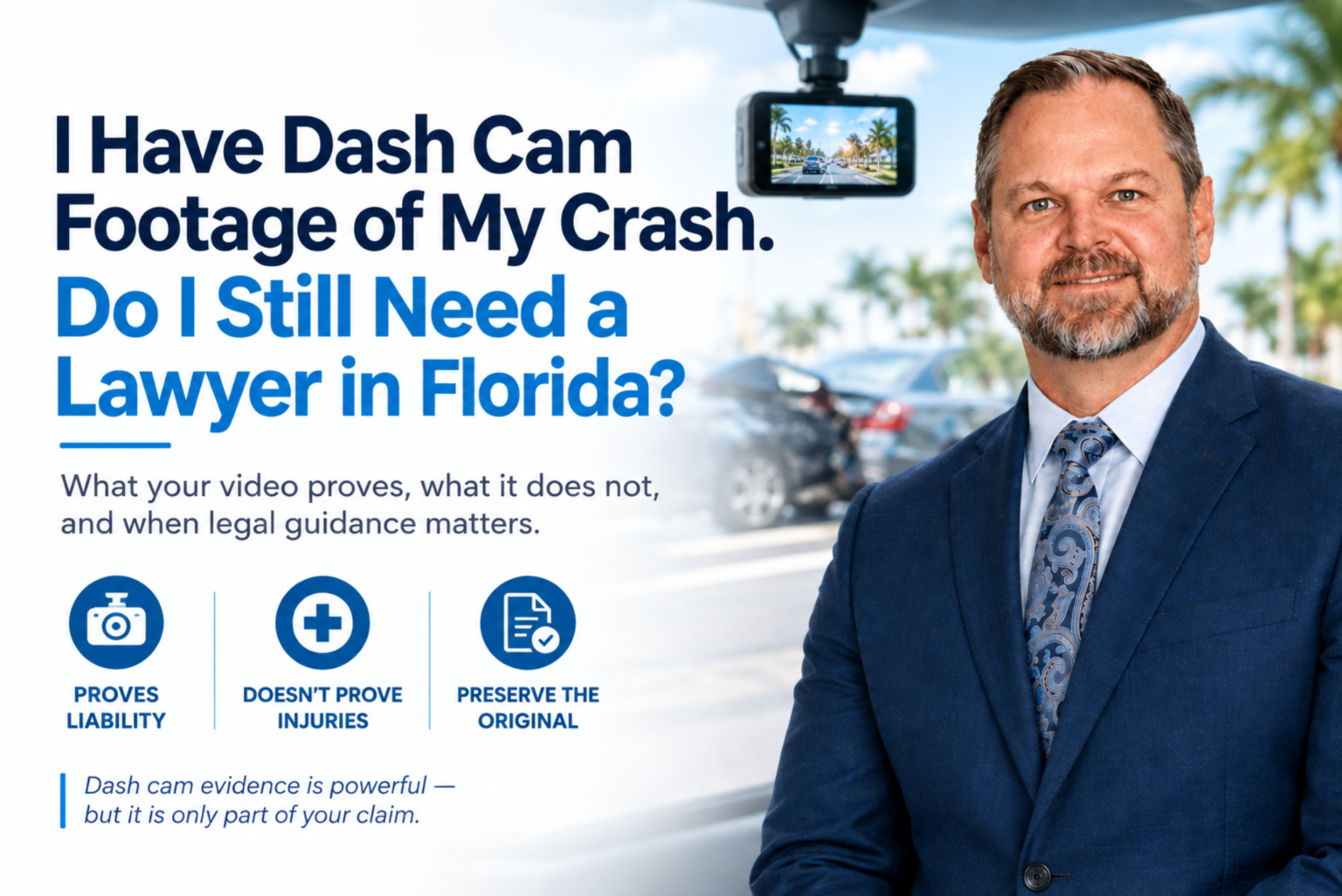
I Have Dash Cam Footage of My Crash. Do I Still Need a Lawyer in Florida?
By Shannon J. Sagan, Esq., The Dash Cam Lawyer®, Fla. Bar #10793
Dash cam footage helps, but it does not replace a lawyer. Video proves what happened on the road. It does not prove what your injuries are worth, it does not stop an insurer from blaming you, and it does not extend your deadlines. Talk to a lawyer before you talk to any insurance company, including your own.
What Your Dash Cam Footage Actually Proves
Dash cam footage is strong evidence on one specific legal question, liability, or who was at fault. A forward facing camera can show the color of the light, the lane the other driver came from, whether a signal was used, following distance, closing speed, and the moment of impact. That is the part of a claim that usually turns into one driver’s word against the other.
In Florida that question carries more weight than it used to. Since House Bill 837 took effect on March 24, 2023, Florida uses modified comparative negligence under section 768.81(6), Florida Statutes. A person found more than 50 percent at fault for their own harm recovers nothing. At 50 percent or less, the recovery is reduced by the assigned percentage. Fault is no longer a discount. Past a certain point it is a wall, and video is the cleanest way to keep you on the right side of it.
Dash cam footage has never been more valuable than now. .
What Dash Cam Footage Does Not Prove
Video cannot show a herniated disc. It cannot show why you still cannot lift your child, why you missed eleven weeks of work, or what your care will cost three years from now. Those are damages, and damages are where car accident claims are actually won and lost.
Adjusters know this. When liability is on tape, many stop arguing about fault and start arguing about causation and value instead. The pivot sounds like this, the impact looks minor on the video, so the treatment must be unrelated. There was a gap in your care, so you must have healed. You had a prior injury, so this crash changed nothing.
There is a legal layer above that. Under section 627.737, Florida Statutes, you can only step outside the no-fault system and pursue pain and suffering damages if your injury meets a threshold of significant and permanent loss of an important bodily function, permanent injury within a reasonable degree of medical probability, significant and permanent scarring or disfigurement, or death. Your camera has no opinion about any of that. Your medical records do.
Four Ways a Strong Video Case Still Goes Sideways
1. The footage overwrites itself. Almost every dash cam runs on a loop and records over the oldest files once the card fills. Depending on card size and resolution, that can happen in a matter of hours. Florida heat makes it worse, because high cabin temperatures shorten the life of memory cards and capacitors. Drivers regularly discover days or even hours later that the clip they were counting on is gone.
2. The audio creates a separate problem. Florida is an all party consent state under section 934.03, Florida Statutes. Video alone is not a communication under the statute, so a video only camera is not an issue. Audio is different. If your camera records conversation inside the car and a passenger never consented, that recording can create exposure rather than help you. Know what your camera captures.
3. Authentication is a real step. Under section 90.901, Florida Statutes, evidence has to be authenticated before it comes in, meaning someone with knowledge has to establish that the video is what you say it is. The threshold is not high, but it is not automatic either. Sections 90.952 and 90.953 govern originals and duplicates, so an edited, trimmed, re-encoded, or screen recorded copy invites an argument you do not need. Preserve the original file.
4. You talk yourself into fault. This is the one people never see coming.Almost all people I’ve ever mentioned this to have no idea that sSection 316.066(4), Florida Statutes, keeps the crash report and statements made to the investigating officer for that report out of civil trial. That protection does not follow you to the insurance company. What you say to an adjuster is fair game, and adjusters are trained to ask questions that produce useful answers. A recorded statement given the day after a crash, before you know the full extent of your injuries, can undercut footage that was otherwise going to carry your case.
The Florida Deadlines That Do Not Care How Good Your Video Is
Evidence does not pause the clock. Three dates matter.
The 14 day rule. Under section 627.736, Florida Statutes, you have to receive initial medical services within 14 days of the crash or you forfeit your Personal Injury Protection benefits entirely. PIP provides up to 10,000 dollars in medical benefits, but only if a qualified provider determines you have an emergency medical condition. Without that determination the medical benefit is capped at 2,500 dollars.
The two year filing deadline. For crashes on or after March 24, 2023, section 95.11(5)(a), Florida Statutes, gives you two years to file a negligence lawsuit. That is half the window Florida allowed before House Bill 837.
The uninsured motorist question. Under section 627.727, Florida Statutes, uninsured and underinsured motorist coverage is what you fall back on when the at fault driver has little or no liability insurance (becoming more and more common every month). Perfect footage of a driver with a 10,000 dollar policy and no assets is still a claim against your own coverage, and those claims come with their own notice and cooperation requirements.
What to Do in the Days After the Crash
Get medical attention right away, and in every case within 14 days. This protects your health first and your PIP benefits second.
Preserve the footage the same day. Power the camera down, remove the memory card, and copy the original file to a computer and to a second location such as cloud storage. Do not trim it, do not edit it, and do not record it off a phone screen. Keep the card itself if you can, and put a different card in the camera.
Photograph the scene, the vehicles, and your visible injuries, and collect names and numbers for any witnesses. Video shows the sequence. It rarely shows the damage or the debris field well.
Do not call your own insurance company until you have spoken with an attorney about your rights. Most people call their insurer from the roadside out of pure instinct. I understand why, and I am asking you not to. You do have an obligation to cooperate with your own insurer under your policy, but that obligation does not require you to do it immediately, and the first conversation tends to be the one that causes problems.
Never give a recorded statement to the at fault driver’s insurance company, or to your own, without speaking to an attorney first. This applies even when you have footage. Especially when you have footage, because a confident driver with video is exactly the person who says too much.
Do not post the video publicly. Social media clips get edited, taken out of context, and quoted back to you later. Send it to a lawyer, not to the internet.
When Footage Makes a Lawyer More Valuable, Not Less
Here is the part that surprises people. Clear liability does not reduce what a lawyer adds. It concentrates it. When fault is no longer in dispute, the entire negotiation moves to damages, and damages are the part built out of medical documentation, treating physician opinions, wage records, and a properly presented demand. That is the work.
Your own footage is also only half the available video. The other driver may have a camera. Nearby businesses have exterior cameras that overwrite in days. Commercial vehicles often carry forward and driver facing systems, and in trucking cases federal rules require electronic logging device records to be retained for six months under 49 CFR 395.8(k)(1). None of that arrives on its own. It has to be requested, and preservation letters have to go out before the retention window closes. That is a lawyer’s job, and it is time sensitive in a way most people do not realize until the footage is already gone.
Video wins the argument you were going to win anyway. The claim is decided somewhere else.
Frequently Asked Questions
Does dash cam footage mean I do not need an attorney in Florida?
No. Footage addresses fault. It does not establish the value of your injuries, satisfy the permanent injury threshold under section 627.737, Florida Statutes, protect your PIP benefits under the 14 day rule, or preserve evidence held by other parties. Many claims with excellent video still settle for less than they are worth because the damages side was never developed.
Can I settle my own car accident claim if I have dash cam video?
You can. Whether you should is a different question. A settlement is final. Once you sign a release, you cannot reopen the claim if your symptoms turn out to be permanent, if surgery becomes necessary, or if your medical bills exceed what you expected. Before you accept any number, you should understand your full medical picture, any lien or subrogation claim against your recovery, and whether uninsured motorist coverage applies.
Will the insurance company accept my dash cam footage without a lawyer?
An insurer will usually look at it, and clear video often does move the fault discussion. Accepting the footage is not the same as accepting your valuation. Adjusters routinely acknowledge liability and then dispute causation, treatment, and the amount. In litigation the video also has to be authenticated under section 90.901, Florida Statutes, which is another reason to preserve the original file rather than an edited copy.
How long do dash cams save footage after an accident?
Not as long as most drivers assume. Loop recording overwrites the oldest files continuously, and on a small card at high resolution that can mean hours rather than days. Many cameras lock a clip automatically when the impact sensor triggers, but that only works if the sensor fired and the file was not later overwritten. Treat the footage as something you have to save deliberately, on the day of the crash.
What should I do if the other driver has a dash cam of the accident?
Act quickly. That footage is on a device you do not control, running on the same loop that erases your own. A preservation letter should go out to the driver, the driver’s insurer, and any employer if a commercial vehicle was involved. The sooner that request is made, the better the odds the file still exists.
Do I have to give my insurance company a recorded statement?
Your policy includes a duty to cooperate with your own insurer, and that duty is real. It does not mean you have to give a recorded statement on the insurer’s timeline, before you have finished treating, or without talking to an attorney first. You are never required to give a recorded statement to the at fault driver’s insurance company.
What does it cost to have a lawyer look at my case?
The consultation is free, and my office handles injury cases on a contingency fee. There is no fee unless I recover for you.
Talk Through Your Footage Before You Talk to an Adjuster
If you have dash cam video of a crash in Palm Beach County, the footage is a strong start and a short clock. Call 561-561-DASH (3274) for a free consultation with The Dash Cam Lawyer®. My office serves West Palm Beach, Lake Worth, Boynton Beach, Delray Beach, Wellington, Royal Palm Beach, Jupiter, Belle Glade, and all of Palm Beach County, and my team speaks Spanish. There is no fee unless I recover for you.
This article is general information about Florida law and is not legal advice. Reading it does not create an attorney client relationship. Every case depends on its own facts. If you were injured in a crash, speak with a lawyer about your specific situation.
Looking for an accident Lawyer near you in Palm Beach County? Find Out What Your Case Is Worth - Free Consultation
Call us or complete the form below.
We'll keep your information confidential.
Palm Springs Office
Belle Glade Office
By appointment only