

Most of My Clients Are Convinced They Have Full Coverage. Then I Open the Policy.
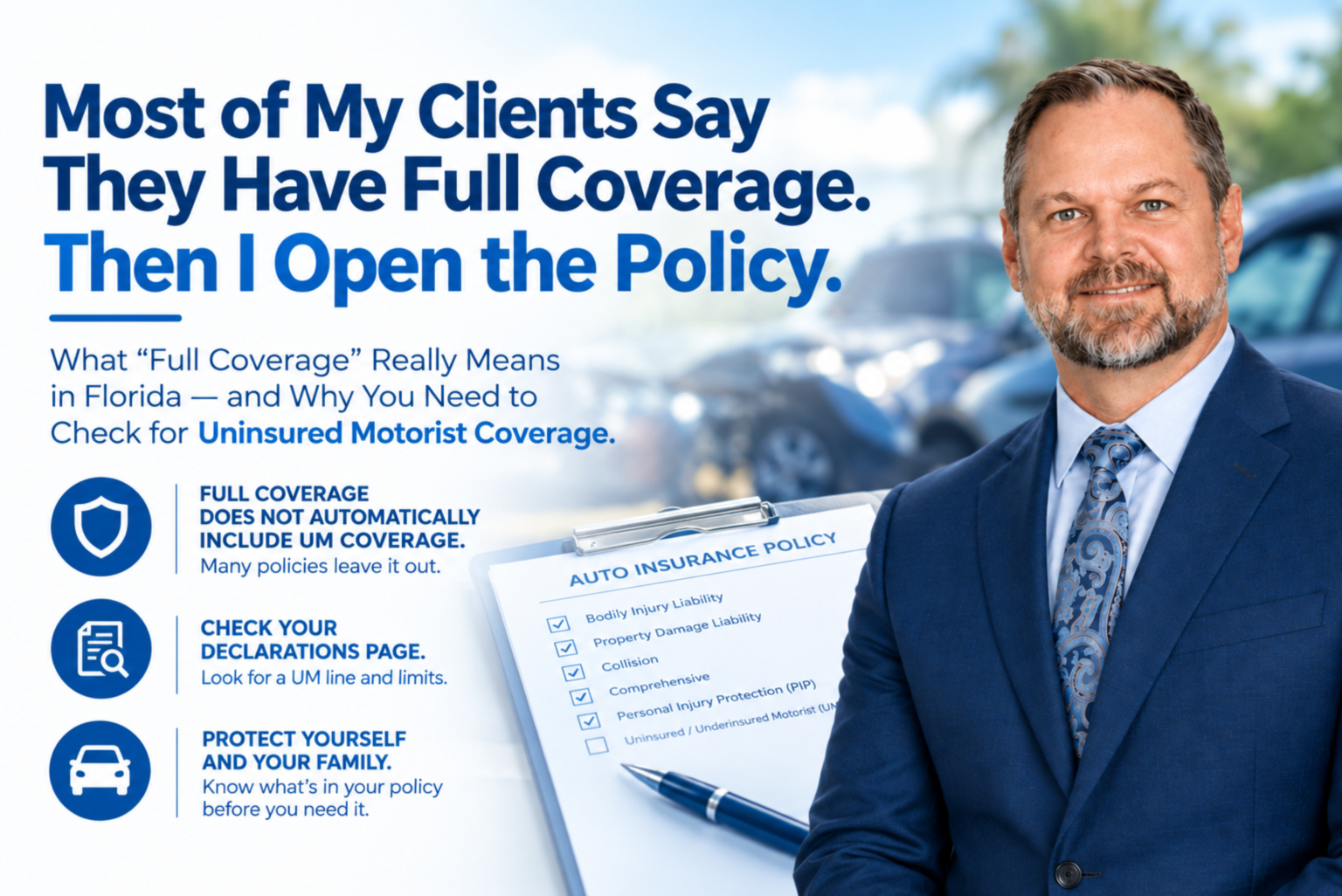
It’s been happening for decades now in my practice. A client gets into a motor vehicle accident, comes to my office and when I ask about their insurance, they tell me they have full coverage. They are pretty confident about it to when I ask if they are sure. Unfortunately though, when I check most of their declarations pages, I often find bodily injury, collision, comprehensive, and PIP coverage. There’s nothing labeled uninsured motorist or underinsured motorist.
Does Florida full coverage include UM? Not automatically. And not because a Florida statute defines “full coverage” as a package that must include uninsured motorist protection. “Full coverage” is sales language. It is not a defined coverage package in the Florida Statutes.
I am Shannon J. Sagan, Fla. Bar #10793, owner and attorney at The Dash Cam Lawyer®. My practice focuses on injury claims in Palm Beach County and throughout Florida. This article covers the misunderstanding of what most people I encounter mean (or think) by full coverage, what usually appears on a declarations page, where UM sits or does not sit, and how to check before a crash. If you were already hit, see my guide on legal options after an uninsured driver crash in Palm Beach County.
What people usually mean by “full coverage”
In everyday talk, full coverage usually means more than Florida’s minimum package of just Property damage and Personal Injury Protection coverage. Typically it consists of:
- Bodily injury liability (pays others if you injure them)
- Property damage liability (pays for damage you cause to someone else’s property)
- Collision (pays to repair or replace your car after a crash)
- Comprehensive (pays for non-crash damage such as theft, vandalism, or weather)
- Personal Injury Protection (PIP), which Florida requires on qualifying private passenger policies and is similar to health insurance.
That list can feel complete, but when it comes to getting injured in an accident, it is not! The gap that surprises people is coverage for your injuries when the other driver has no bodily injury liability insurance, or not enough of it. Known as UM, Uninsured, Underinsured Motorist coverage, it is a back up that protects you and your family in the event you were injured by an uninsured or underinsured driver. I’m seeing about 30-40% of uninsured or underinsured drivers injuring my clients lately.
What usually appears on the declarations page
The declarations page (often called the “dec page”) lists vehicles, drivers, coverages, and limits for the current policy period. It is the first document I ask for when a client is sure the policy is “full.”
Common lines: bodily injury liability, property damage liability, PIP, collision with a deductible, comprehensive (sometimes labeled “other than collision”), and sometimes medical payments, rental, or roadside add-ons.
What you may not see: a line for uninsured motorist injury, underinsured motorist, or stacked versus non-stacked UM. A blank, a zero, a rejection note, or a missing UM row is not a formatting quirk. It means the protection you thought was included may not be there.
I do not guess whether a missing UM line came from an agent conversation, a dealer finance desk, a lease office, a renewal form you signed years ago, or a carrier default. I read what the declarations page and related forms show. The paperwork controls the claim more than the phrase “full coverage” ever will.
Where UM sits under Florida law (briefly)
Under Fla. Stat. § 627.727 (2026), a motor vehicle liability policy that includes bodily injury liability coverage generally must also offer uninsured motorist coverage for insureds who are legally entitled to recover from an uninsured (or, in many situations, underinsured) motor vehicle. The named insured can reject UM in writing (which just about everyone does), or select lower limits than the bodily injury limits, on a form the statute describes.
UM is tied to bodily injury liability coverage and to written elections. It is not automatically glued to collision or comprehensive. A policy can look “full” for the car and still have a signed rejection, lower UM limits, or no UM line on the declarations page.
PIP is separate. Under Fla. Stat. § 627.736 (2026), personal injury protection provides required no-fault medical and disability benefits (and death benefits) subject to the statute’s rules, including initial care within 14 days for medical benefits. PIP can help with early bills regardless of fault. It does not replace UM when the at-fault driver has no bodily injury coverage for your injuries.
For how a UM claim works after you have already been hit, use the July 10 uninsured driver article. This post is about catching the gap before the crash.
Don’t Rely on Someone Else’s Opintion. How YOU can check for UM before a crash
You need the current declarations page and, when available, any UM selection or rejection form tied to the policy.
- Pull the current declarations page from your insurer’s portal, app, or mailed packet. Confirm the effective dates match today.
- Look for “uninsured motorist,” “UM,” “UIM,” or “uninsured/underinsured motorist.”
- Note the UM limits next to your bodily injury liability limits. If BI is listed and UM is blank, zero, “rejected,” or absent, treat that as a red flag.
- Ask your insurer for any signed UM rejection or lower-limits selection form on file.
- If you have more than one vehicle, ask whether UM is stacked or non-stacked.
- After any vehicle purchase, lease, refinance, or policy rewrite, request a fresh declarations page the same week.
If you did not purchase bodily injury coverage, than you definitely do not have the necessary UM coverage for you and your family.
If the page is unclear, ask the carrier for written confirmation of UM limits (or confirmation that UM was rejected). Do not rely on a verbal “you have full coverage.” Ask for the line item.
What happens after a crash if there is no UM
If you are hurt and the at-fault driver has no bodily injury liability coverage (or not enough), and your own policy has no UM, the recovery path gets narrow fast. PIP may still apply under § 627.736 if you qualify, allowing you up to $10,000 in medical care, but it’s not necessarily money in your pocket (absent lost wages). Beyond that, options depend on other responsible parties, available liability policies, and the facts.
Collecting from an uninsured individual personally is often impractical and I nor a lot of my colleagues will not go after an uninsured/underinsured driver because if they cannot afford proper coverage, the odds are they do not have assets to personally collect from them (absent very rare circumstances).
Read my Palm Beach County uninsured driver guide for what to do after you are hit. Check the declarations page while you can still change the policy.
Again: do not call your own insurer before speaking with an attorney. Never give a recorded statement to any insurer first.
A dash cam does not replace coverage
I focus on video evidence because it can lock down fault, speed, lane position, and what happened before impact. That matters when fault share is disputed.
Video does not create insurance limits that are not on the policy. A clear clip of an uninsured driver running a red light does not invent UM coverage on your declarations page. Evidence and coverage are different tools. Use both.
For how footage fits into a Florida claim, see how to use dashcam footage in a Florida car accident claim.
Frequently asked questions
Does “full coverage” mean I have uninsured motorist coverage in Florida?
No. Full coverage is marketing language, not a statutory package. Many policies people call full coverage include liability, collision, comprehensive, and PIP but not the most important one, UM. Read the declarations page for an uninsured motorist line and limits.
Is uninsured motorist coverage required in Florida?
Florida generally requires insurers to OFFER UM with bodily injury liability policies under, but it is not required to have. Required offer is not the same as required purchase.
What should I look for on my declarations page to confirm UM?
Look for a row labeled uninsured motorist, UM, UIM, or uninsured/underinsured motorist, with dollar limits. Compare those limits to your bodily injury liability limits. A missing, zero, or rejected row means you may not have the protection you expected.
Can I have collision and comprehensive and still lack UM?
Yes. Collision and comprehensive primarily protect the vehicle. UM primarily protects you (and certain insureds) for injury damages when the at-fault driver is uninsured or underinsured.
If my agent said I have full coverage, is that enough?
No way. Ask for the current declarations page and any UM rejection or selection form. I decide what coverage exists from the policy documents, not from a sales phrase.
Should I wait until after a crash to check for UM?
No. After a crash, you cannot go back and buy UM for that loss. Check the declarations page now, after every vehicle change, and at renewal.
Does PIP cover what UM would cover?
No. PIP under Fla. Stat. § 627.736 is no-fault coverage with its own limits and conditions. UM responds when you are legally entitled to recover from an uninsured or underinsured motorist and you carry that coverage. They serve different roles.
Talk to The Dash Cam Lawyer® about your policy questions
If you are reviewing a declarations page before a crash, or you were hurt and just learned the other driver has little or no bodily injury coverage, I can review what the paperwork shows and explain your options. I can assure you, most people I have ever spoken with who tell me they have full coverage, do not have UM coverage.
There is no fee unless I recover for you. Call 561-561-DASH (3274).
The Dash Cam Lawyer®. Shannon J. Sagan, Fla. Bar #10793, owner and attorney. Palm Springs and Belle Glade offices, serving Palm Beach County.
This article is for general information only and is not legal advice. Reading it does not create an attorney-client relationship. Every case is different. Consult a licensed Florida attorney about your specific situation.
Looking for an accident Lawyer near you in Palm Beach County? Find Out What Your Case Is Worth - Free Consultation
Call us or complete the form below.
We'll keep your information confidential.
Palm Springs Office
Belle Glade Office
By appointment only