
Who Is Liable When a Commercial Truck Hits You in Florida?
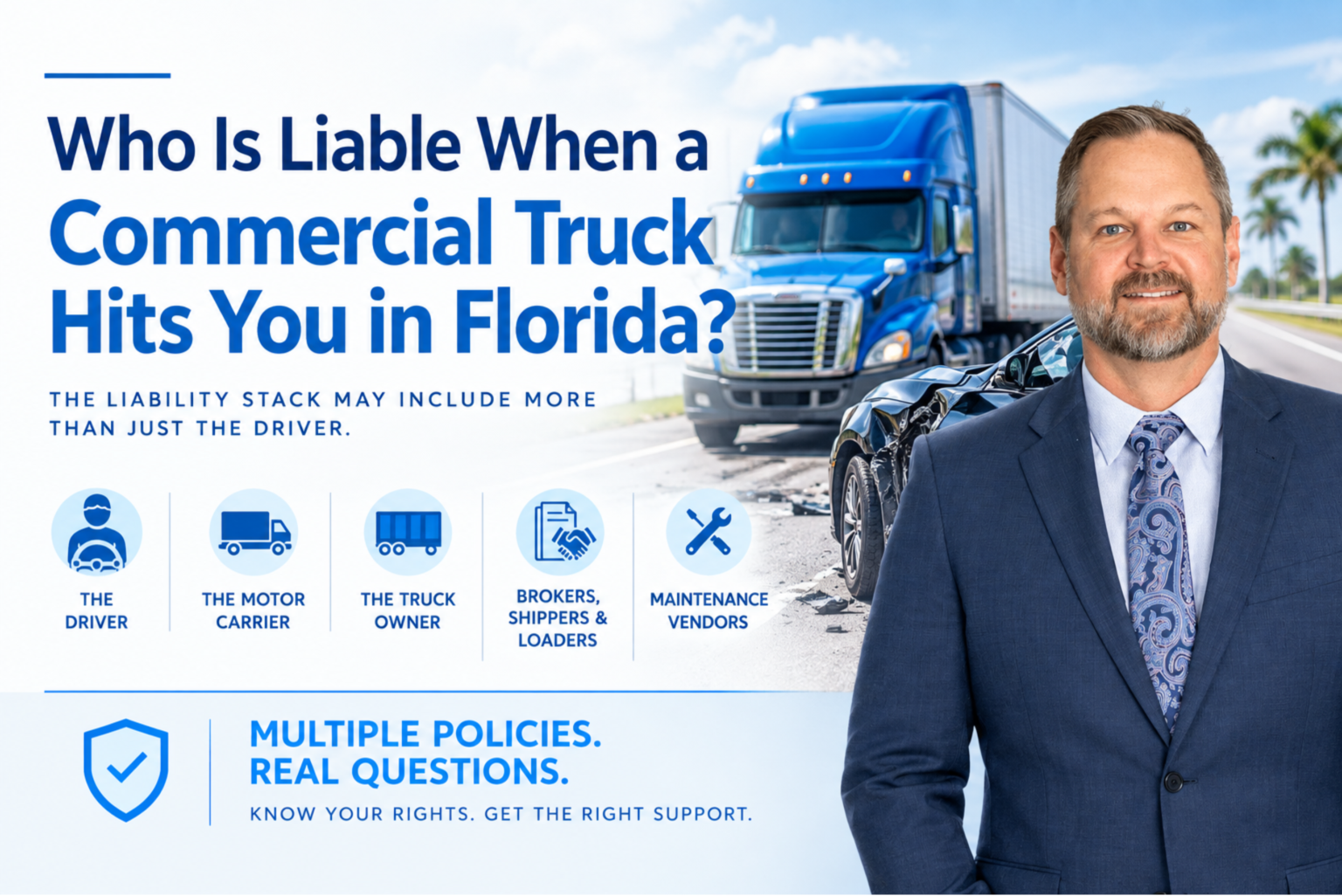
A commercial truck crash looks like one collision. Liability often is not one person. The driver may share responsibility with the motor carrier, the owner of the tractor or trailer, and, on some facts, a broker, shipper, cargo loader, or maintenance vendor. Florida also layers personal injury protection (PIP), bodily injury liability limits, and sometimes uninsured or underinsured motorist coverage in that same stack.
I am Shannon J. Sagan, Fla. Bar #10793, The Dash Cam Lawyer®. My practice focuses on Palm Beach County injury claims, including trucking and commercial vehicle crashes, where video and electronic data often decide who did what before impact.
Do not call your own insurer before speaking with an attorney. Duty to cooperate is not immediate. Never give a recorded statement to any insurer first, including your own.
This article explains the liability stack in plain English. It is not a promise of results, and it does not discuss claim valuation numbers. For West Palm Beach freight corridors, see my 18-wheeler accident lawyer West Palm Beach page. If a relative cannot speak after a semi crash, start with what to do when a family member is hit by a semi in Florida.
The liability stack is not always “just the driver”
People often assume the truck driver is the only defendant. Sometimes that is true. Often it is not.
A tractor-trailer, box truck, dump truck, or fleet van can involve several companies on one load: the motor carrier with USDOT authority, a leased owner-operator, a separate trailer owner, a freight broker, a shipper, and a shop that last worked on the brakes. Liability follows the facts of that trip, not a single logo on the door.
Note the company name, USDOT number, trailer markings, and any broker stickers you can safely photograph. Those details help counsel map who may owe a duty and which policies may apply.
The truck driver
The driver can be liable for negligent operation: speeding, following too closely, failing to yield, distracted driving, fatigue, improper lane change, or driving while impaired. A crash report is a starting point, not the final word. Witnesses, roadway cameras, and the truck’s own systems may tell a different story than a rushed roadside interview.
Some drivers are employees. Some are independent contractors or leased owner-operators. That label can affect how a motor carrier is sued, but it does not erase the driver’s duty of care.
Do not argue fault at the scene. Get medical care, call 911 when needed, and preserve what you can. Counsel can sort employment status later from dispatch, lease, and payroll records.
The motor carrier and trucking company
The motor carrier is often the company that operates the commercial vehicle under federal and state authority. It may hire or lease drivers, set dispatch schedules, set hours-of-service policies, and control how the load moves.
A carrier can face claims for its own negligence, such as negligent hiring, retention, training, or supervision, when the facts support those theories. A carrier may also face liability for a driver’s negligence when the driver was acting within the scope of the relationship that put that truck on your road. The exact theory depends on the documents and the trip, not on marketing language on the cab.
Carriers and their insurers move fast after a serious crash. They may send an investigator within hours. That person does not represent you. Direct every inquiry to counsel. The same rule applies to a “safety contractor” hired by the carrier.
The truck owner
Ownership and operation are not always the same company. One entity may own the tractor. Another may own the trailer. A third may lease the equipment to the motor carrier.
Florida law looks at ownership, control, and agency facts. A logo on the door is a clue, not a complete answer. Title records, lease agreements, and insurance declarations often matter more than paint on the cab.
If a light commercial van hit you rather than an 18-wheeler, the stack can still include a fleet owner and a delivery contractor. Ask who controlled the vehicle and the driver that day.
Brokers, shippers, cargo loaders, and maintenance vendors
Not every truck crash reaches beyond the driver and motor carrier. Some do.
Freight brokers arrange transportation between shippers and carriers. Whether a broker can be liable turns on that booking: how the carrier was selected, what the broker knew or should have known, and what role the broker played beyond matching a load. There is no automatic broker liability in every Florida truck case, and no rule that a broker is always off the table when selection facts support a claim.
Shippers and cargo loaders can matter when cargo shift, overweight loading, or improper securement contributes to loss of control or a rollover. Bills of lading, load photos, scale tickets, and securement records become important.
Maintenance vendors and repair shops can enter the picture when a mechanical failure (brakes, tires, steering, lighting) contributes to the crash and the work history shows who last touched the truck. Shop invoices, inspection reports, and parts records are the usual proof.
I raise these parties only when the evidence points that way. Stretching a claim to every company on a bill of lading without facts helps no one.
Multiple policies, thin limits, and UM reality
Commercial crashes often involve more than one insurance file: the driver’s policy (if any), the motor carrier’s liability policy, an owner’s policy, and sometimes excess or umbrella coverage. Your own auto policy may also matter for PIP and, if purchased, uninsured or underinsured motorist (UM) protection.
Florida minimum liability limits can be thin relative to a serious injury. That is a coverage fact, not a prediction of what any case is “worth.” If at-fault limits are low, or a driver flees, uninsured motorist coverage on your policy (when you bought it) may become part of the picture. UM elections are policy-specific.
Do not treat the first adjuster who calls as the only coverage in play. Do not sign a release tied to a quick property-damage check before counsel maps the policies. A broad release can close doors you did not know existed.
Dash cams, truck cameras, ECM, and ELD data
The useful proof in a commercial truck case is often electronic, and much of it sits with the trucking company.
Many trucks store engine control module (ECM) data such as speed, braking, and engine events around a hard stop. Fleet cameras may face forward, toward the driver, or both. Electronic logging device (ELD) records speak to hours of service. Dispatch systems and telematics can show route pressure and timing. Bills of lading and maintenance files fill in the rest.
Those materials are not kept forever. Onboard video is often overwritten in days or weeks. A preservation letter from counsel puts the carrier on notice to hold ECM downloads, camera footage, ELD records, dispatch logs, cargo paperwork, and post-crash inspection results.
If your car had a dash cam, save the original file the same day. Do not edit it. How dash cam footage is used in a Florida claim matters because the clip may show lane position, brake lights, and the seconds before impact. Ask nearby businesses and other drivers to hold their video too.
I focus on Palm Beach County corridors where freight and passenger traffic mix, including US 27, Florida’s Turnpike approaches, I-95, and local arterials. The preservation steps are the same for an 18-wheeler or a commercial box truck.
PIP’s 14-day clock
Florida’s no-fault law, Fla. Stat. § 627.736, pays personal injury protection from your motor vehicle coverage (or, in some household situations, a resident relative’s policy), not from the trucking company’s liability policy. PIP can cover a share of medical bills and lost income up to statutory limits, with a separate death benefit.
Initial services and care generally must begin within 14 days of the crash under § 627.736(1)(a). An ER trip from the scene usually meets that timing. Follow-up still has to be documented. Missing that window can cut off PIP medical benefits even when the truck was clearly at fault.
PIP is not a reason to sit for a long recorded interview about how the crash happened. Identifying the policy for the hospital is different from narrating fault on a recorded line.
Modified comparative fault in Florida
Florida follows modified comparative fault. Under Fla. Stat. § 768.81(6), a party found greater than 50 percent at fault for his or her own harm may not recover any damages in a negligence action to which that section applies. If you are 50 percent or less at fault, your recovery is reduced by your percentage of fault.
Trucking carriers and their insurers know this rule. Early recorded statements that speculate (“maybe I was going a little fast,” “I might have looked down”) become exhibits in a fault fight. That is one reason not to call your own insurer before speaking with an attorney, and never to give a recorded statement to any insurer first.
Fault percentages turn on evidence: reconstruction, video, ECM data, and witnesses. Guessing at the scene helps the defense more than it helps you.
Two years to file, far less time to keep the proof
For most negligence lawsuits, Fla. Stat. § 95.11(5)(a) sets a two-year period. That is a filing deadline, not a reason to wait. Truck camera loops overwrite. ECM data can be lost when a tractor is repaired or put back in service. PIP’s 14-day care rule is already running.
Practical order after a commercial truck hits you:
- Medical care first.
- Crash report number, carrier name, USDOT number, and photos you can safely take.
- Save any passenger-car dash cam file, and ask nearby cameras to hold footage.
- Call a lawyer about preservation letters and the liability stack.
- Do not call insurers for a recorded statement, and do not sign a release.
Frequently asked questions
Is the trucking company always liable if its driver caused the crash?
Not automatically in every fact pattern, and not always under the same legal theory. Many cases involve the motor carrier because of the driver’s negligence within the scope of that relationship, the carrier’s own negligence, or both. Employment status, leases, and dispatch control all matter. Counsel sorts that from documents, not from the logo alone.
Can a freight broker be liable?
Sometimes, when carrier selection or the broker’s role supports a claim. Many crashes never reach the broker. Do not assume either way until the booking file is reviewed.
What if the truck had low insurance limits?
Low bodily injury limits are common relative to serious injuries. Mapping every applicable policy, including your own UM coverage if you purchased it, matters early. Thin limits are not a reason to give a recorded statement or sign a quick release.
Should I talk to the trucking company’s investigator so they have accurate facts?
No. The investigator works for the carrier or its insurer. Accurate facts come from the crash report, vehicle data, cameras, and discovery later. Direct them to counsel.
Does the duty to cooperate mean I must give a statement today?
No. Do not call your own insurer before speaking with an attorney. Duty to cooperate is not immediate. Never give a recorded statement to any insurer first, including your own and the trucking company’s carrier.
How is this different from a regular car crash claim?
Commercial cases add carrier documents, ELD and ECM data, fleet cameras, possible broker or shipper issues, and often multiple policies. The insurer block, PIP timing, and modified comparative fault rules still apply. The proof package is larger and easier to lose without a preservation demand.
Talk with me before you call an insurer
If a commercial truck hit you in Florida, call 561-561-DASH (3274). Consultations are free to start the conversation. Contingency fee: no fee unless I recover for you. That is not a prediction of results. It is how the fee works if you hire me.
I can help map the liability stack, send preservation demands for ECM data, fleet cameras, ELD records, and cargo files, and keep you from walking into a recorded statement or a release that closes the wrong door.
The Dash Cam Lawyer®. Shannon J. Sagan, Fla. Bar #10793, owner and attorney. Palm Springs and Belle Glade offices, serving Palm Beach County.
This article is general information, not legal advice. Reading it does not create an attorney-client relationship. Florida law and facts vary by case. Consult a licensed Florida attorney about your situation.
Looking for an accident Lawyer near you in Palm Beach County? Find Out What Your Case Is Worth - Free Consultation
Call us or complete the form below.
We'll keep your information confidential.
Palm Springs Office
Belle Glade Office
By appointment only