
What to Do After a Family Member Is Hit by a Semi Truck in Florida
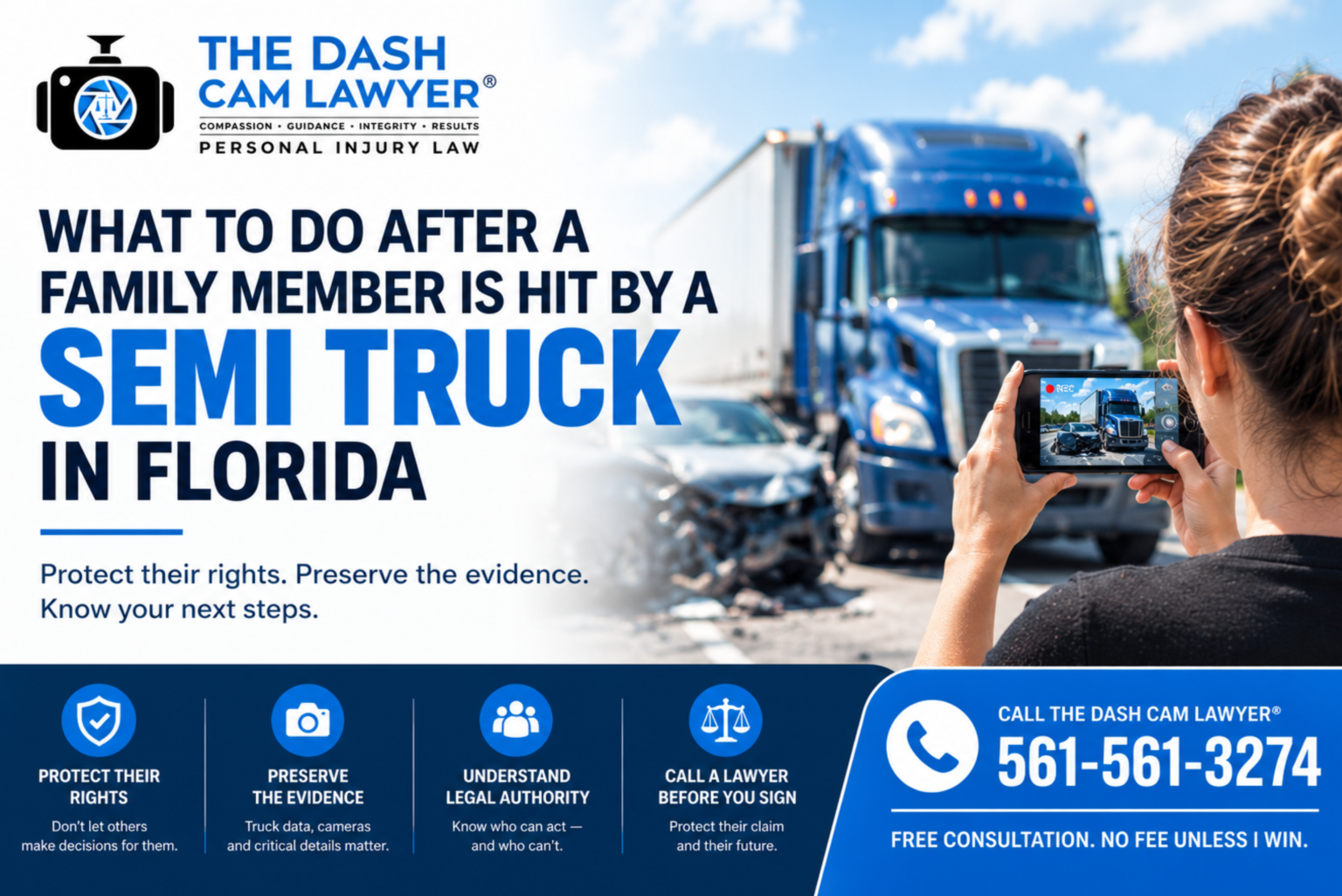
The injured person is in the hospital. They may be unconscious, intubated, or unable to speak. You are the one in the waiting room, and someone from the trucking company or an insurance carrier already wants to “get the family’s side” and have you sign papers so they can “move things along.” That is a different problem from a typical crash, because the person who was hit cannot act. I wrote this as a guide for family members going through something like this.
I am Shannon J. Sagan, Fla. Bar #10793, The Dash Cam Lawyer®. My practice focuses on injury claims in Palm Beach County and throughout Florida, including semi truck crashes, where video and electronic data often decide what happened.
Do not call your own insurer before speaking with an attorney. Do not call the injured person’s insurer before speaking with an attorney either. The duty to cooperate with a policy does not require doing it immediately. Never give a recorded statement to any insurer first.
When the injured person cannot act
Semi collisions often leave a passenger-car occupant unable to hire counsel, describe the crash, or reject a release. Surgery, sedation, a brain injury, or death all pause that person’s ability to act.
Hospitals will treat first. That is the right order. In those hours you can ask for the crash report number, photograph the vehicles if it is safe, and write down the truck’s name and USDOT number. You cannot stand in for an adult on a settlement just because you are the spouse, parent, or adult child.
Write a simple timeline while it is fresh: who called 911, which hospital, which officers or crash report numbers you heard, and every person who asked for a statement or a signature. That list helps counsel later and keeps the family from arguing from memory alone.
If the person later wakes and has capacity, the claim belongs to them. Until then, treat every request to “cooperate” as a request that may bind someone who cannot consent.
Medical decisions are not claim decisions
Florida separates health care authority from the power to settle a crash claim. A designated health care surrogate under Fla. Stat. § 765.202 can make many treatment choices for an incapacitated adult. If there is no surrogate, Fla. Stat. § 765.401 allows a proxy (often a spouse, then adult children, then parents, in statutory order) to make health care decisions. That authority covers medical care. It does not authorize a liability release, a recorded statement about fault, or a settlement with the trucking company’s insurer.
Keep those lanes separate:
- Talk with the care team about surgery, consent forms, and discharge.
- Do not mix those conversations with adjuster calls about “closing the file” or “trying to move the file along”.
- If someone asks you to sign both a hospital form and an insurance release in the same visit, stop and call a lawyer before you touch the insurance paper.
For a broader overview of how serious injury claims unfold for victims and families, see my Palm Beach County serious injury claims article. This post goes deeper on who may act when a semi crash leaves a relative unable to speak for themselves.
Who has authority to speak, and who does not
Florida does not give next of kin a blank check to act for an injured adult.
The injured adult. If they are conscious and have capacity, they speak for themselves. Family members should not guess about speed, phones, lane changes, or who cut whom.
An agent under a durable power of attorney. Fla. Stat. § 709.2201 limits an agent to authority specifically granted in the document. A vague line that the agent may do “all acts” the principal could do is not an express grant. Even a valid power of attorney may omit claims and releases. Read the instrument before anyone assumes it covers a trucking settlement.
A healthcare surrogate or proxy. Medical decisions only, as above. Not claim settlements.
A court-appointed guardian of the property. A guardian may petition the court to approve a settlement. Fla. Stat. § 744.387 generally requires that approval, including after a lawsuit has started. A guardian does not sign a release in a hospital hallway.
A personal representative after death. If the crash is fatal, a court-appointed personal representative typically pursues the estate’s claim under Florida’s Wrongful Death Act (Fla. Stat. § 768.16 through 768.26). Being the spouse or child is not, by itself, that appointment. Certain survivors may have their own statutory damages under § 768.21, but filing and any release still turn on who the court has authorized.
Minors. Parents (natural guardians) have limited authority. Under § 744.387(2), a small net settlement may be handled without a full guardianship. When the net amount to the minor exceeds $15,000, Florida generally requires a guardianship of the property. Do not sign a trucking company’s form for a child just because you are the parent on the clipboard.
If you do not hold one of those roles, you can still gather facts and ask a lawyer to send preservation letters. You cannot bind the injured adult.
A family member cannot sign a release without legal authority
Insurers know families are exhausted. They offer a quick check “for the car” or “to help with the hospital” and slide a release across the table. Broad language can wipe out the injury claim, future care, and, in a death case, survivor claims.
Do not sign. Do not initial a “statement of facts.” Do not accept a property-damage check tied to a general release. A signature by someone who lacks authority may be attacked later, but undoing a release is harder than refusing it on day one. If someone already signed, tell a lawyer immediately and stop talking to that adjuster.
Do not talk to the trucking company’s investigator
Carriers often send a rapid-response investigator to a serious semi crash within hours. That person may sound kind and say they only need “the family’s account” while memories are fresh.
They do not represent the injured person. Their job is to lock a story, shift blame, and collect statements before anyone has counsel. Do not walk the scene with them. Do not hand over phones, memory cards, or keys. Do not speculate about what the driver “must have” done. Direct every inquiry to an attorney. The same rule applies to a “safety contractor” or reconstruction vendor hired by the carrier.
If an investigator leaves a card at the hospital desk or texts a sibling who was not in the car, that is still a defense contact. One family member should be the single point of “please talk to counsel,” so the carrier cannot shop for the softest answer.
Preserve the truck’s data, cameras, and cargo records
The useful proof is usually in the trucking company’s possession. The company and its insurer will look at hours of service, maintenance, and onboard video. Many trucks also store engine control module (ECM) data, forward-facing and driver-facing cameras, telematics, bills of lading, and load-securement records.
Those files are not kept forever. Onboard video is often overwritten in days or weeks. A preservation letter from counsel puts the carrier on notice to hold ECM data, fleet cameras, cargo paperwork, dispatch records, and post-crash testing.
If the family car had a camera, save the original file the same day. Do not edit it. How dash cam footage is used in a Florida claim matters here because the clip may show the truck’s lane, brake lights, and the seconds before impact. Nearby businesses and other drivers may have cameras too. Ask them to hold the video. Do not wait for the injured person to wake up before that request goes out.
Families in Belle Glade, the Glades, and western Palm Beach County see heavy freight on US 27 and related corridors. My Belle Glade trucking accident page covers that corridor in more detail. The family steps in this article still apply countywide.
PIP runs on the injured person’s auto policy
Florida’s no-fault law, Fla. Stat. § 627.736, pays personal injury protection (PIP) from the injured person’s motor vehicle coverage (or, in some household situations, a resident relative’s policy), not from the trucking company’s liability policy. PIP can cover a share of medical bills and lost income up to statutory limits, with a separate death benefit. Initial services and care generally must begin within 14 days of the crash under § 627.736(1)(a). A trip to the emergency room from the scene usually meets that timing. Follow-up still has to be documented.
PIP is not a reason to sit for a long recorded interview. A relative who is only trying to get the hospital paid can identify the policy and the date of loss without narrating the crash. Handing a registrar a policy card is different from answering “who was at fault” on a recorded line. If the trucking company has thin liability coverage, or the driver fled, uninsured motorist coverage on the injured person’s policy (if it was purchased) may become part of the picture. UM elections are policy-specific.
Recorded statements and the duty to cooperate
Do not call your own insurer before speaking with an attorney. The duty to cooperate with the injured person’s carrier is real. It does not require doing it immediately. Never give a recorded statement to any insurer first, including the family’s carrier, the injured person’s carrier, and the trucking company’s carrier.
Adjusters record calls. Early answers given while you are in shock (“I think they were speeding,” “I’m sure they are going to be fine”) follow the file for years. Florida insurance policy laws can make policy compliance, including an examination under oath, a condition of PIP benefits. That is a formal process with notice, not a hallway interview on day one.
If you are unsure when to hire a lawyer after a Florida crash, treat incapacity, a commercial truck, and any request for a recorded statement as reasons to call before you dial an insurer.
If the semi driver left the scene
Call 911. Insist on a crash report. Note plate numbers, trailer markings, and any camera that may have seen the truck. Fla. Stat. § 316.027 addresses crashes involving death or personal injury, and § 316.062 covers the duty to give information and render aid. A hit-and-run does not end the civil claim. It changes where coverage may come from. Do not wait for an arrest. The civil clock still runs.
Two years to file, far less time to keep the proof
For most negligence lawsuits, Fla. Stat. § 95.11(5)(a) sets a two-year period. Wrongful death actions are also generally two years under § 95.11(5)(e). Those are filing deadlines, not a reason to wait. Truck data can be gone in weeks. PIP’s 14-day care rule is already running.
Practical order for the family, when the injured person cannot act:
- Medical care and hospital communication (surrogate or proxy as needed).
- Crash report number, carrier name, USDOT number, and photos you can safely take.
- Save any passenger-car dash cam file, and ask nearby cameras to hold footage.
- Call a lawyer about preservation letters and who has authority to hire counsel.
- Do not call insurers for a recorded statement, and do not sign a release.
That sequence protects the person in the bed without pretending that kinship alone settles a commercial claim.
Frequently asked questions
Can I hire a lawyer if my family member is unconscious?
You can contact a lawyer, share what you know, and ask for preservation letters. Whether you can hire counsel to prosecute the injured adult’s claim depends on your legal authority (power of attorney, guardianship, or, after death, personal representative status). Do not delay preservation while those questions are sorted out. A free consultation is a place to sort those roles without a fee to start the conversation.
Can a spouse sign a release for an unconscious adult?
Not necessarily by being the spouse. Signing a release for an adult requires actual legal authority, such as a power of attorney that specifically grants that power, a court-appointed guardian acting with required court approval, or a personal representative in a death case. If you lack that authority, do not sign.
Who brings the claim if my family member dies?
Usually a court-appointed personal representative, under Florida’s Wrongful Death Act, with certain survivors having their own statutory damages under § 768.21. The two-year period in § 95.11(5)(e) still applies.
Should I talk to the investigator so the company has “accurate facts”?
No. The investigator works for the trucking company or its insurer. Accurate facts come from the crash report, vehicle data, and cameras. Direct them to counsel.
How does PIP get paid if the injured person cannot call?
A relative can often help the hospital identify the auto policy so they can send the bill timely. That is different from sitting for a recorded statement about how the crash happened. Do not call the insurer for a long interview before speaking with an attorney.
What if the semi driver left the scene?
Report it at once. §§ 316.027 and 316.062 address stopping, remaining, identifying, and aiding. Preserve every camera you can find. Coverage may involve the injured person’s uninsured motorist protection if it exists.
Does a duty to cooperate mean someone must give a statement today?
No. Do not call your own insurer before speaking with an attorney. The duty to cooperate does not require doing it immediately. Never give a recorded statement to any insurer first.
Can a health care surrogate settle the truck claim?
No. A surrogate or proxy under chapter 765 decides medical care. Settling a crash claim or signing a liability release requires separate legal authority (and often court approval).
Talk with me before anyone in the family signs
If a family member was hit by a semi truck in Florida, call 561-561-DASH (3274).
Consultations are free to start the conversation. Contingency fee: no fee unless I recover for you. That is not a prediction of results. It is how the fee works if you hire me.
I can help sort who has authority, send preservation demands for ECM data, fleet cameras, and cargo records, and keep the family from walking into a recorded statement or a release they cannot undo.
The Dash Cam Lawyer®. Shannon J. Sagan, Fla. Bar #10793, owner and attorney. Palm Springs and Belle Glade offices, serving Palm Beach County.
This article is general information, not legal advice. Reading it does not create an attorney-client relationship. Florida law and facts vary by case. Consult a licensed Florida attorney about your situation.

Looking for an accident Lawyer near you in Palm Beach County? Find Out What Your Case Is Worth - Free Consultation
Call us or complete the form below.
We'll keep your information confidential.
Palm Springs Office
Belle Glade Office
By appointment only