
Truck Dash Cam Footage in a Florida Truck Accident Claim: How It Is Preserved and Used
By Shannon J. Sagan, Esq., The Dash Cam Lawyer®, Florida Bar No. 10793
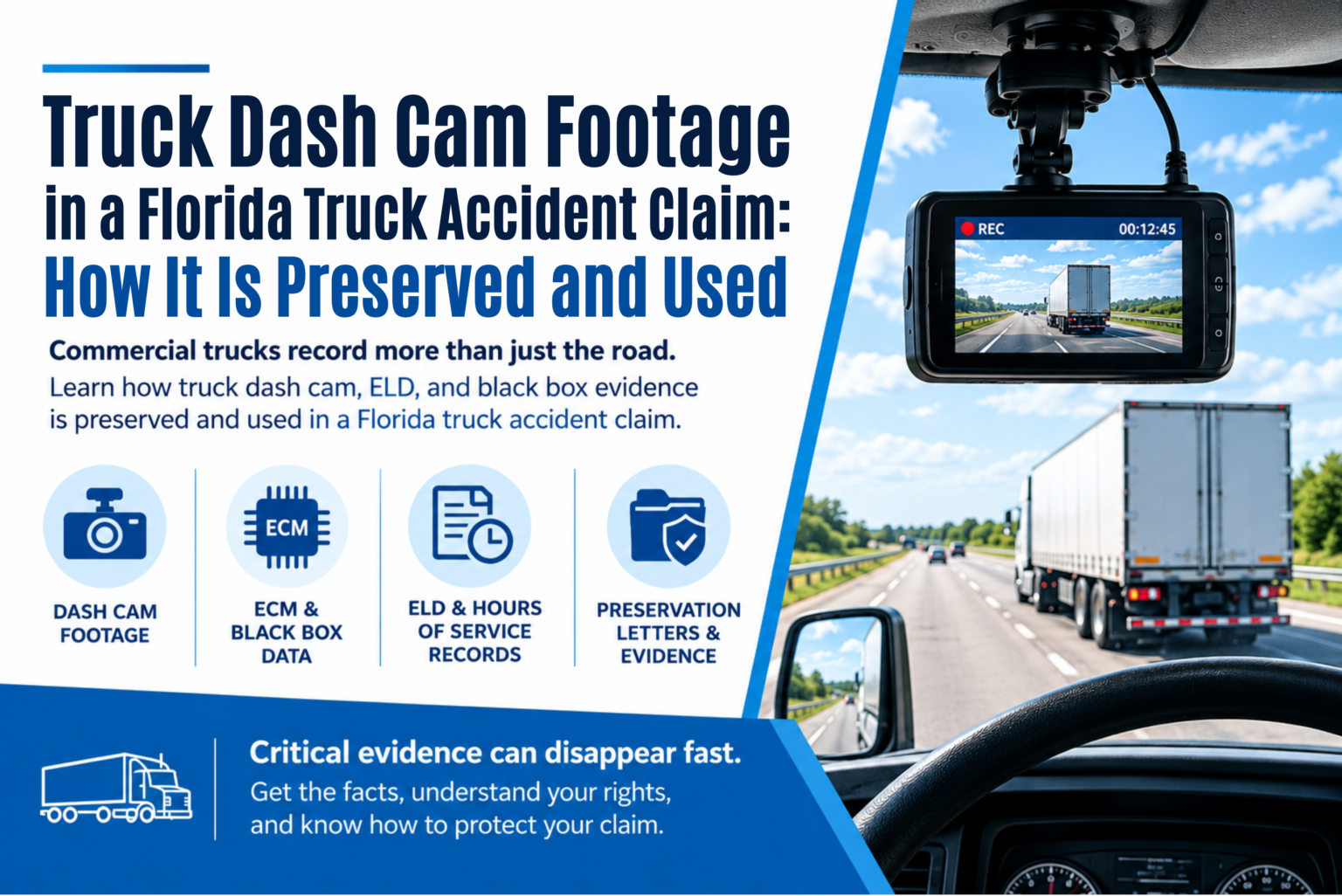
These days most commercial trucks on Florida roads record. Forward facing dash cams, driver facing cameras, engine control modules, and electronic logging devices all capture data. That evidence belongs to the trucking company, and much of it is overwritten within days. A written preservation letter, sent quickly, is what stops the deletion clock.
Do semi trucks have dash cams in Florida?
Usually, yes. Camera systems went from optional to standard across most large fleets over the last decade, because insurers reward them and because carriers use the video to defend claims. A typical tractor trailer running I 95 or the Turnpike may carry several recording systems at once:
- A forward facing camera aimed at the road ahead.
- A driver facing camera aimed into the cab, often triggered by hard braking, swerving, or a collision.
- A telematics unit that reports speed, location, and harsh events back to a dispatch office in near real time.
There is a hard truth in that list. The video that shows what happened sits with the company whose driver hit you, and nobody there has an incentive to hand it over quickly. That is why the request has to be formal, specific, and early.
The evidence that disappears first
Different systems on the same truck have very different memories. Knowing which clock is running fastest tells you where to push first.
Dash cam video. Most in cab systems record on a continuous loop and write over old footage once storage fills. Some upload flagged events to the cloud automatically; others keep only what is on the card. Days, sometimes hours, is a realistic window.
Engine control module (ECM) and event data. NHTSA has described non event ECM data as customarily overwritten within roughly 250 ignition cycles, about sixty days of ordinary use. In practice it goes sooner. If the truck keeps running, key data can be overwritten in seven to thirty days, and a battery disconnect during repair can corrupt the record before anyone looks at it.
Hours of service records. Under 49 CFR 395.8(k)(1) a motor carrier must keep records of duty status and the supporting documents behind them for six months from the date of receipt. Supporting documents include bills of lading, dispatch records, fuel purchase receipts, toll records, and payroll documents. FMCSA guidance also expects a backup copy of electronic logging device data to be kept on a separate device for the same six months.
How truck dash cam footage actually gets preserved
The tool is a preservation letter, sometimes called a spoliation letter: a written demand to the motor carrier, its insurer, and its registered agent, identifying the crash and instructing the company not to destroy, alter, or return to service anything holding evidence.
A preservation letter in a truck case should name the categories of evidence specifically, because a vague letter is easy to ignore. An example of some of the things to potentially ask that they preserve:
- All forward facing, driver facing, side, and rear camera footage for a defined window before and after the crash, in native format with metadata intact.
- ECM and event data recorder downloads, plus the tractor itself, held out of service until an inspection can be scheduled.
- Electronic logging device records, records of duty status, and every supporting document listed in 49 CFR 395.8.
- Dispatch records, load assignments, GPS and telematics data, and driver messaging.
- The driver qualification file, drug and alcohol testing records, and the training file.
- Maintenance and repair records, inspection reports, and any post crash repair invoices.
Related: How to Use Dashcam Footage in a Florida Car Accident Claim
What Florida law does when the evidence is destroyed
Florida no longer allows a separate lawsuit for first party spoliation. In Martino v. Wal Mart Stores, Inc., 908 So. 2d 342 (Fla. 2005), the Florida Supreme Court held that an independent cause of action for spoliation will not lie where the alleged spoliator and the defendant in the underlying case are the same party. The Court reasoned that existing tools were enough: discovery sanctions, an adverse inference instruction, and a rebuttable presumption of negligence.
In plain terms, if a trucking company destroys footage after being told to keep it, the remedy usually comes inside the case rather than as a separate claim. A jury can be told it may infer that the missing video would have been unfavorable to the company. That is a meaningful position to be in, and it is only available if the request was made and documented first.
The federal safety rules that make a truck case different
A crash between two passenger cars is governed mostly by ordinary negligence. A crash with a commercial truck brings in a rulebook. The Federal Motor Carrier Safety Regulations, 49 CFR parts 382 through 397, cover drug and alcohol testing, commercial driver licensing, hours of service, and vehicle inspection and maintenance.
Those rules are not only for interstate carriers. Florida Statute section 316.302 adopts parts 382 through 386 and 390 through 397 for owners and drivers operating commercial motor vehicles in intrastate commerce, as those federal rules existed on December 31, 2023, with limited exceptions. A local hauler running only between Belle Glade and Riviera Beach is still inside the rulebook.
Insurance limits are different too. Under 49 CFR 387.9, minimum financial responsibility for a for hire carrier of general freight in interstate commerce is $750,000, and $5,000,000 for certain hazardous materials. Many national fleets carry far more. That matters because the size of the available coverage often decides whether a catastrophic injury claim can actually be paid.
How to find out if a truck driver violated the hours of service rules
You do not take the logs at face value. You cross check them. Electronic logging devices made falsified paper logs harder, but they did not make them impossible, and the useful conflicts show up between systems that were never meant to be reconciled.
- Compare the electronic logging device record against fuel purchase receipts and toll transactions. A fuel stop at 3:10 a.m. is hard to square with a log showing the driver off duty in a sleeper berth.
- Compare GPS and telematics pings, and the dash cam time stamps, against the duty status changes.
- Pull dispatch records and driver messaging to see what the driver was told about delivery windows.
- Check the carrier through the FMCSA public safety data systems for its inspection and violation history.
- Request the driver qualification file and the maintenance file, which show whether the driver should have been behind the wheel and whether the equipment should have been on the road.
When those records disagree, the disagreement itself becomes evidence. Every one of those categories belongs on the preservation letter for exactly that reason.
Your own dash cam footage in a truck case
If you had a camera running, you may hold the single most useful piece of evidence in the case. Protect it before you do anything else.
Pull the memory card or lock the file so the loop cannot overwrite it. Keep the original, unedited, with its metadata, and note the camera make and model. Under Florida Statute section 90.901 evidence must be authenticated before it comes in, and the cleanest way to authenticate video is to show it is the untouched original from a device you can describe. Do not post it publicly while a claim is pending.
Audio is a separate question. Florida Statute section 934.03 is an all party consent law, and intercepting a private oral communication without the consent of everyone involved is a criminal offense. Video only recording does not trigger it, because pure video is not a communication under the statute. If your camera records in cab audio and you carry passengers, get their consent first. Driving alone, you consent to your own speech.
Who is liable when a commercial truck hits you in Florida
Rarely just the driver. A single truck crash can involve several responsible parties, and identifying them early affects how much coverage is available:
- The driver, for negligent operation.
- The motor carrier, both for the driver’s conduct within the scope of employment and directly for negligent hiring, training, retention, or supervision.
- A broker or shipper, where the load or the schedule created the danger.
- A maintenance contractor, where a brake or tire failure traces back to bad work.
- A cargo loading company, where a shifting or overweight load contributed.
- A parts or vehicle manufacturer, in a defect case.
Florida applies modified comparative negligence under Florida Statute section 768.81. A recovery is reduced by your share of fault, and if you are found more than fifty percent at fault you recover nothing. That rule is precisely why the video matters so much. Fault percentages get argued. Video is the argument that does not change its story.
More: Who Is Liable When a Commercial Truck Hits You in Florida.
What to do in the days after a truck crash
If you are reading this for a family member who was seriously hurt, start at step one anyway. The evidence steps do not wait for anyone to get out of the hospital.
- Call 911 and make sure a crash report is generated. For a commercial vehicle, ask that the report capture the USDOT number.
- Photograph the tractor and trailer unit numbers, the USDOT and motor carrier numbers on the door, any placards, and the full scene including skid marks and debris.
- Get names and phone numbers for witnesses before they leave. Truck crashes draw witnesses who scatter fast.
- Secure your own dash cam footage immediately, as described above.
- Get medical attention within fourteen days. Florida Statute section 627.736 conditions personal injury protection benefits on initial services being received within fourteen days of the crash.
- Do not call your own insurance company until you have spoken with an attorney about your rights. Almost everyone reaches for the phone at the roadside out of instinct. You do have a duty to cooperate with your own insurer under your policy, but that duty does not require you to do it in the first hour, or before you understand what you are agreeing to.
- Do not give a recorded statement to anyone, the at fault trucking company’s insurer or your own insurer, without speaking to an attorney first. Recorded statements are taken early precisely because that is when you know the least about your own injuries.
- Get a preservation letter out to the carrier and its insurer.
Related: What to Do After a Family Member Is Hit by a Semi Truck in Florida.
Florida deadlines and insurance rules that apply to truck claims
Statute of limitations. Florida Statute section 95.11(5)(a) gives two years to file a negligence lawsuit for claims that accrued on or after March 24, 2023, when HB 837 took effect. Older claims may fall under the prior four year period. Two years sounds long. In a case that needs a federal records fight and a crash reconstruction, it is not.
Personal injury protection. Florida is a no fault state and PIP or Personal Injury Protection benefits kick in at: $10,000 in benefits, eighty percent of reasonable medical expenses, sixty percent of lost wages, the fourteen day treatment deadline, and a $2,500 cap unless a qualifying emergency medical condition is determined.
Stepping outside no fault. Florida Statute section 627.737 allows a claim against the at fault party for pain and suffering when the injury meets the permanent injury threshold. Serious truck crash injuries routinely do.
Uninsured and underinsured coverage. Florida Statute section 627.727 governs UM and UIM benefits, which can still matter when available truck coverage is exhausted by multiple claimants.
Frequently asked questions
Do semi trucks have dash cams in Florida?
Most large fleets now run camera systems, commonly a forward facing camera and often a driver facing camera, plus telematics that report speed and location. Smaller owner operators vary. Assume footage exists and demand it.
How do I get truck dash cam footage after an accident in Florida?
You send a written preservation letter to the motor carrier, its insurer, and its registered agent identifying the crash and demanding that all camera footage, ECM data, and logging records be preserved in native format. If the company will not produce it voluntarily, the footage is obtained through discovery once suit is filed. Send the letter within days. The recording loop does not pause for a claim.
How long does a trucking company keep dash cam and log records?
Records of duty status and their supporting documents must be kept six months under 49 CFR 395.8(k)(1). Dash cam video has no comparable federal retention rule, and loop recording systems can overwrite in days. ECM data can be overwritten in as little as seven to thirty days of continued operation.
Can I get the footage myself without a lawyer?
You can send a preservation letter yourself, and doing so is better than doing nothing. What you cannot do on your own is compel production, take a corporate deposition about the retention system, schedule an inspection of the tractor, or ask a court for an adverse inference if the video vanishes. Those tools open when a case is filed.
How do I find out if a truck driver violated federal safety rules after a crash?
By cross checking the electronic logging device record against fuel receipts, toll transactions, GPS data, dispatch messages, and dash cam time stamps, and by requesting the driver qualification file, drug and alcohol testing records, and maintenance records. The carrier’s inspection and violation history is also available through FMCSA public safety data systems.
Who is liable when a commercial truck hits you in Florida?
Potentially the driver, the motor carrier, a broker or shipper, a maintenance contractor, a cargo loader, or a manufacturer. Florida Statute section 316.302 applies the federal safety rules to intrastate carriers as well, so a local hauler is held to the same standards.
Should I talk to my insurance company before calling a lawyer?
Speak with an attorney first. Your policy requires cooperation, but nothing requires you to give a statement immediately, and nothing requires you to give a recorded statement to the trucking company’s insurer at all. Get advice on what you are obligated to say before you say it.
How long do I have to file a truck accident lawsuit in Florida?
Two years from the crash for negligence claims accruing on or after March 24, 2023, under Florida Statute section 95.11(5)(a). Waiting costs more in a truck case, because the records you need are being deleted on federal retention schedules while the deadline runs.
Talk with me about your truck accident case
I am Shannon J. Sagan, The Dash Cam Lawyer®. My practice is built around video evidence in crash cases, and truck cases are where that evidence carries the most weight and disappears the fastest. If you or a family member was hit by a semi truck, an 18 wheeler, a box truck, or any commercial vehicle in Palm Beach County, the preservation clock started at the moment of impact.
Consultations are free. There is no fee unless I recover for you. Call 561-561-DASH (3274) or use the contact form on this site, and bring whatever footage you have.
Serving Palm Beach County, including West Palm Beach, Belle Glade, Boynton Beach, Delray Beach, Lake Worth, Greenacres, Wellington, Jupiter, Royal Palm Beach, and Riviera Beach.
This article is general information about Florida law and is not legal advice. Reading it does not create an attorney client relationship. Every case turns on its own facts, and laws change. For advice about a specific situation, speak with a licensed Florida attorney.

Looking for an accident Lawyer near you in Palm Beach County? Find Out What Your Case Is Worth - Free Consultation
Call us or complete the form below.
We'll keep your information confidential.
Palm Springs Office
Belle Glade Office
By appointment only